

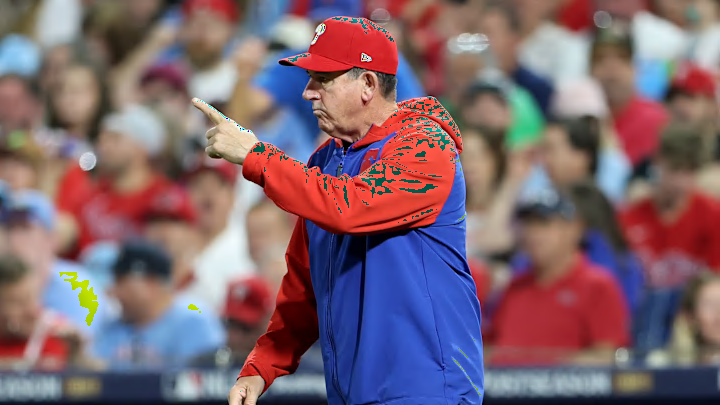
The Philadelphia Phillies teeter on the brink of elimination in this year’s playoffs thanks to dropping a pair of home games against the Los Angeles Dodgers to begin their best-of-five NLDS, and there is a lot to be agitated about.
Los Angeles is collecting clutch hits while the Phillies have not, and several agonizingly close plays have made a big difference. Sometimes, though, it comes down to tactical decision-making, and Phillies skipper Rob Thomson’s choice to have Bryson Stott bunt in the ninth inning of Game 2 could go down as the worst move by any Philadelphia coach or manager this century.
Rob Thomson's bunt call in ninth inning of Game 2 all but ended Phillies' season
To painfully reset the scene, the Phillies offense was listless for eight innings on Monday until Dodgers manager Dave Roberts made a rare misstep to bring Blake Treinen into the game. The Phillies greeted him with three straight hits, with Nick Castellanos representing the tying run at second base after barely hustling out a double. With Stott due up, Roberts couldn’t remove Treinen fast enough, bringing in lefty Alex Vesia.
You should always be able to cash in on a situation with a man at second and no outs, and there are various ways to achieve it. You have to know your personnel, though, so it’s extremely curious why Thomson gave Stott the bunt sign with the slow-footed Castellanos at second. Maybe if he had pinch-run for him at this point, you could understand it, but he didn’t.
At any rate, Stott showed bunt on the first pitch, which was high for a ball. The Dodgers were tipped off, and they were ready. At this point, Thomson could have waved off the bunt, but he didn’t. Stott got off a good bunt on the 1-0 offering, but it wasn’t good enough, as the Dodgers executed on defense to nail Castellanos at third. According to Baseball Reference, this single play increased the Dodgers’ win probability for the game from 54 percent to 78 percent.
The Dodgers cut down the potential tying run at third base! #NLDS pic.twitter.com/eDHzvZYVha
— MLB (@MLB) October 7, 2025
Of course, pinch hitter Harrison Bader came up and whacked a single right after that, meaning that the Phillies would have had men on the corners with one out (Casty probably doesn’t score on it) had Stott just struck out rather than laying down the unsuccessful sacrifice. The Phillies still had a chance even after this botch job, but if you search deep in your Philadelphia fan soul, you knew that they would lose this game after the bunt went awry. The team is now 2-9 in the playoffs since going up 2-0 in the 2023 NLCS against Arizona. They simply can't meet the moment.
These are the kinds of decisions that haunt a manager, a team, and a fan base for decades. Sometimes you need to play it safe, but this was clearly not the time.
The Phillies offense had gone scoreless for 14 straight innings prior to Game 2’s late rally, yet Thomson clung to some vain hope that they should play for the tie and trust their bats to actually do something in extra innings rather than going for the jugular when the team finally had some momentum.
“No,” Thomson said about not wanting Stott to swing away, per Phillies Nation's Ty Daubert. “I wanted to play for the tie. I liked where our bullpen was compared to theirs.”
It was simply a "wuss move," to use a PG-rated term for what I’ve been calling it since it happened. We see it across all sports when teams play to not lose instead of playing to win.
When the Phillies’ season ends with a whimper some time over the next few days in Los Angeles, blame will be passed around like Grandma's sweet potato casserole at Thanksgiving, as well it should. And a lot of that food should fall in the lap of Rob Thomson, whose tenure in town may well have run its course. You can expect a lot of change for the Phillies in advance of the 2026 season, and it shouldn’t be a shock at all if there’s a new manager pulling the strings for whatever group of players doesn’t get run out of town.
 Add us as a preferred source on Google