

The Phillies’ first selection in the 2026 MLB Draft will not come until No. 36 overall, where the slot value is $2,758,800. There's always good talent to acquire in that range.
But Philadelphia’s draft becomes especially interesting after that. The Phillies own a $7,773,000 bonus pool, and their next five selections are No. 64 ($1,416,600), No. 100 ($784,400), No. 128 ($597,400), No. 135 ($558,400 compensation pick for losing Ranger Suárez) and No. 161 ($433,200).
That is important to note because the Phillies’ system is entering an transition phase. Andrew Painter and Justin Crawford have already graduated to the major-league picture. While Aidan Miller still gives the organization star-level upside, much of the system’s depth now feels concentrated near the top. If Philadelphia wants to continue operating aggressively at the major-league level while maintaining future trade flexibility, the middle portion of this draft could become incredibly important.
The Phillies could quietly reshape organizational depth after the first round
Alex Weingartner, two-way athlete, St. Augustine Prep (NJ)
If the Phillies want to chase athletic upside with pick No. 64, Alex Weingartner feels like one of the cleaner fits on the board. Perfect Game’s 2026 Top 400 listed Weingartner at No. 72 overall, placing him almost directly in Philadelphia’s second-pick range.
Weingartner is a Penn State commit from St. Augustine Prep in New Jersey, and Penn State’s signing-day bio notes that he helped St. Augustine win a 2024 state championship and a 2025 conference championship while earning All-Conference and All-South Jersey honors.
The two-way background matters because players with that type of athleticism often give organizations more developmental flexibility. Weingartner has also shown arm strength on the mound, with Five Tool noting a 90-93 mph fastball and Perfect Game describing him as a 2026 RHP/MIF with a lean, athletic frame.
The Penn State commitment could complicate signability, but that's also why the Phillies’ $1.416 million slot at No. 64 becomes important.
Ryan Lynch, RHP, North Carolina
Ryan Lynch feels like one of the more realistic college arm fits for Philadelphia somewhere around picks No. 100 or No. 128. Perfect Game ranked the North Carolina right-hander No. 116 overall, and the Moorestown, New Jersey native has a profile that fits the middle of Day 2.
Lynch’s freshman season gave evaluators real reason to pay attention. North Carolina’s bio notes that he was named a Freshman Second Team All-American by both D1Baseball and Baseball America after posting a 5-1 record, 2.92 ERA and 72 strikeouts in 61 1/3 innings in 2025.
This season, the picture is a little more complicated. Lynch had a 4.44 ERA in 77 innings with 70 strikeouts, 29 walks and a .285 opponents' batting average. MLB Pipeline’s draft video also says he has a power sinker that sits 94-96 mph.
That gives the Phillies plenty to work with, but there's also plenty to question. Lynch has starter traits and velocity, but he may need to miss more bats and limit hard contact more consistently at the next level. In this range, though, that is exactly the kind of college arm a contender can try to refine into future depth or trade value.
Deven Sheerin, RHP, LSU
Deven Sheerin may be the most naturally interesting fit for Philadelphia’s compensation-round selection at No. 135. Perfect Game ranked him No. 137 overall, which aligns almost perfectly with where the Phillies pick after losing Ranger Suárez.
Sheerin is also a Pennsylvania product, though the exact high school background matters here: LSU lists him as being from Reading, Pennsylvania and attending Exeter Township High School, not Governor Mifflin. He is a 6-foot-5, 255-pound redshirt sophomore who previously pitched at Mount St. Mary’s before joining LSU.
The appeal is easy to understand. D1Baseball lists Sheerin’s 2026 line at 3-2 with a 5.02 ERA and 58 strikeouts, and the raw stuff is louder than the surface numbers. Prospect Porch reported that Sheerin has been up to 99 mph with a fastball that has life and carry, along with a sharp upper-80s slider that could become a plus pitch.
For the Phillies, the developmental hook is obvious. If Sheerin can clean up some mechanical efficiency, the velocity could play even better while helping create more consistent spin and command. The ERA may keep him in this draft range, but the frame, arm strength and SEC experience create legitimate upside.
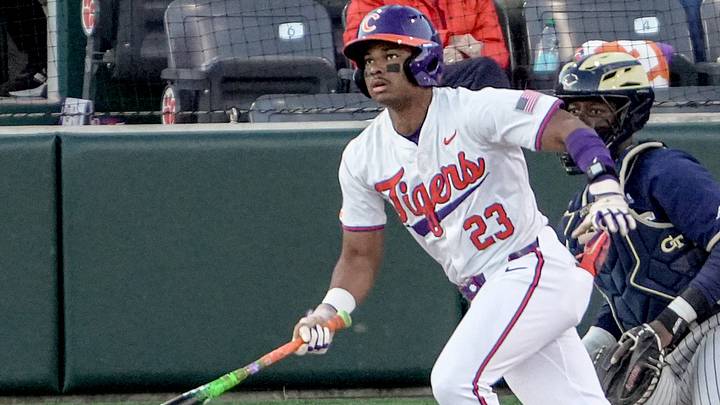
Jarren Purify, 2B, Clemson
If the Phillies want a college position player with athleticism and contact skills later in Day 2, Jarren Purify is a name worth knowing. Baseball America lists Purify as the No. 187 prospect in the 2026 class, while recent Clemson coverage cited Perfect Game ranking him No. 144.
Purify is not an outfielder; he has primarily been a Clemson infielder and second baseman. Clemson’s roster bio describes him as a career .276 hitter with a .386 on-base percentage, 17 doubles, four triples, nine home runs, 63 RBI, 86 runs, 49 walks, 23 hit-by-pitches, and 40 stolen bases over his first two seasons.
His 2026 production has pushed the profile forward. D1Baseball lists Purify hitting .354 with five home runs, 21 RBI, 35 runs and 45 hits this season, and the overall package is built around athleticism, contact and defensive value.
For Philadelphia, Purify would not be the loudest upside play, but he fits the type of player who can help deepen a system quickly. The Phillies need more athletic position player options who can defend, run and put the ball in play. Around the No. 161 range, that kind of profile becomes much more interesting.
The Phillies do not need to force one specific demographic after pick No. 36, but they do need to maximize value throughout the middle of the draft. Whether it is Weingartner’s athleticism, Lynch’s starter traits, Sheerin’s power arm, or Purify’s contact-and-speed profile, this is the range where Philadelphia could quietly strengthen the entire organization.
 Add us as a preferred source on Google