

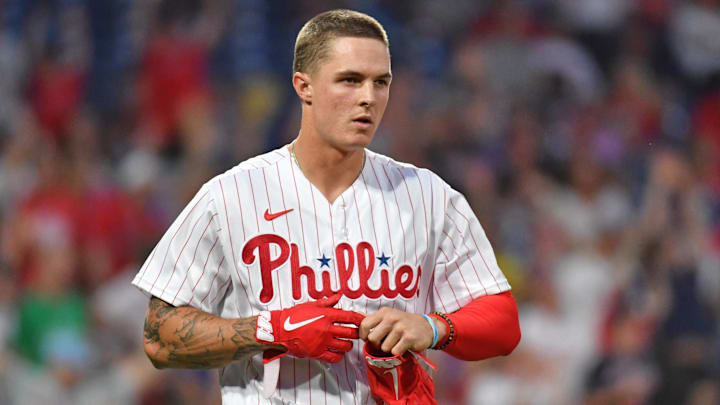
Last weekend’s series finale loss to the Colorado Rockies brought back some unwanted feelings for Philadelphia Phillies fans. Former first overall pick Mickey Moniak flourished in a Rockies uniform, something he was never able to do as a Phillie. The public sentiment surrounding Moniak’s place in Phillies history is that of an all-time draft bust, but it’s time for that to change.
To properly understand the riddle of Mickey Moniak let’s travel back in time to 2015. The Phillies were in the beginning stages of what ended up being a miserable decade-long rebuild following the organization’s 2007-11 heyday. 2008 World Series hero Jimmy Rollins had been traded away the previous offseason, and fellow franchise icons Chase Utley and Cole Hamels followed him out the door that summer.
The Phillies were at a transitional point, still retaining a few of the old guard in Ryan Howard and Carlos Ruiz, but had begun handing the reins over to young bucks like Aaron Nola, César Hernández and Maikel Franco. To fill the gaps, embattled general manager Ruben Amaro Jr. employed the husks of once-talented players like Jeff Francoeur, Aaron Harang, Grady Sizemore and Chad Billingsley. Simply put, the team was a mess. It should come as no surprise that the Phillies lost a league-worst 99 games in 2015, and in so doing were awarded the first overall pick in the next summer’s amateur draft.
Mickey Moniak made his way to the Phillies at one of the darkest points in franchise history
Like all major sports, the draft is a moment of excitement and anticipation, as the stars of tomorrow find their future homes. The first overall pick can be a franchise-altering asset, as generational talents Ken Griffey Jr., Bryce Harper and Alex Rodriguez have been selected in that spot. More recently, the likes of Paul Skenes and Adley Rutschman have made immediate impacts on their clubs.
Unfortunately, things aren’t always that simple, and draft classes frequently lack an obvious standout talent at the top. The Phillies had the misfortune of picking first in one of the thinnest drafts in recent memory, where no single player looked to be a future franchise cornerstone.
By the time the draft rolled around in June of 2016, Amaro had been shown the door and was replaced by analytical guru Matt Klentak. One of Klentak’s first big decisions was who to select with the first overall pick. The front office settled on California high schooler Mickey Moniak, an outfielder who didn’t project to be the next Barry Bonds, but had displayed a solid glove and decent wheels to go along with an above-average hit tool and middle-of-the-pack pop. At the time, MLB.com’s Carlos Collazo compared Moniak to Christian Yelich if everything broke right.
We all know that things didn’t quite turn out that way, as Moniak struggled in his first two full seasons of minor league ball, posting OPS marks of .625 and .687 in Low-A and High-A, respectively. Fans were ready to give up on the then-20-year-old after he showed little improvement, but 2019 was a bit of a step in the right direction, and he ended up making his big league debut in the pandemic-shortened 2020 season.
Moniak rode the shuttle between Triple-A and the big leagues from 2020-2022, appearing in 47 total games for the Phils in that time. Unfortunately, he posted an appalling .386 OPS across 105 plate appearances with the club, justifying the concerns of many that he just wasn’t cut out to be a major league regular.
In fact, Moniak’s biggest contribution came to the Phillies not from his play on the field, but at the 2022 trade deadline, when he was shipped to the Los Angeles Angels alongside minor league outfielder Jadiel Sanchez in exchange for starting pitcher Noah Syndergaard. The Phillies were desperate for a fifth starter after Zach Eflin went on the shelf, and the former New York Mets superstar fit the bill. Syndergaard wasn’t anything special at that point in his career, but he turned in 54 ⅔ innings of 4.12 ERA ball, solidifying the back end of the rotation.
The Phillies let Syndergaard walk in free agency that winter following the team’s National League pennant run, and with that, all ties to the Mickey Moniak experience were gone. No All-Star selections, no rousing standing ovations, not even a single Opening Day start. All Moniak gave the Phillies were a scattering of games across three seasons and some backend starting pitch depth down the stretch. That may not seem like much, but believe it or not that’s a heck of a lot more than most teams got out of their 2016 first round picks.
In a dreadful 2016 draft class, Mickey Moniak was far from the worst
Let’s take a look at the guys that were drafted after Moniak and see what could have been if the Phillies went in a different direction. After all, one of the worst what ifs in Philadelphia sports history was the Eagles taking Jerome McDougle one pick ahead of Hall of Famer Troy Polamalu back in 2003. Did the Phillies pass up on a gamechanger for Moniak?
As luck would have it, no they did not. The man who was drafted number two overall by the Cincinnati Reds (and actually received a larger signing bonus than Moniak) was Nick Senzel. The University of Tennessee product played five years in the Queen City, where he posted a .671 OPS while bouncing all over the diamond. Not good.
Ian Anderson went third overall to the Atlanta Braves and provided some postseason heroics on the way to a 2021 World Series victory, but otherwise had his career completely derailed by injuries. Anderson may have done a bit more for the club that drafted him than Moniak, but not by much. After Anderson went Riley Pint and Corey Ray, two players who are now retired after blink-and-you’ll-miss-it cups of coffee in the Show.
It’s not until the sixth selection that we find a player who has had a substantially better major league career than Mickey Moniak. Towering southpaw A.J. Puk was drafted by the then-Oakland Athletics, and like most good players on the A’s found himself traded before he earned any real money. The 30-year-old Puk has posted a solid 3.53 career ERA for the A’s, Miami Marlins and Arizona Diamondbacks, and despite multiple prolonged absences due to injury would have been a much better selection for the Phillies.
There’s no need to go one-by-one through the entire first round, but a few of the players who gained a bit of traction in the big leagues are Cal Quantrill, Gavin Lux, Eric Lauer and Dylan Carlson. Some of those guys are perhaps an improvement over Moniak, but not meaningfully so. One tragic tale is that of eleventh overall selection Kyle Lewis, who won a Rookie of the Year Award in 2020, but found himself out of the big leagues at 28 years old due to injuries with only 146 career games played. What could have been.
There were only two players taken in the 2016 first round that went on to become All-Stars: Cole Ragans and Will Smith. Ragans struggled to find his footing with the Texas Rangers, but came into his own after a trade to the Kansas City Royals, and has worked to a lifetime 3.72 ERA across 394 ⅔ innings.
Ragans would have been a fine get for the Phillies, but the real one that got away was Smith. A talented catcher from the University of Louisville, Smith went 32nd overall to the Los Angeles Dodgers, the bane of the Phillies existence last season. In his eight big league seasons, Smith has earned himself three All-Star nods and three World Series rings, even smashing the go-ahead home run in last year’s game seven. Overall, the 31-year-old has a .264/.358/.475 slash line in 733 career games, and has garnered a reputation as one of the top catchers in the sport. Would’ve been nice to have in Philly.
Fans may complain about what Mickey Moniak failed to become in Philadelphia, but the fact of the matter is that the Phillies were dealt a bad hand. Sure, they could’ve taken Will Smith, Cole Ragans, or A.J. Puk and secured a better player. With the gift of hindsight we know that they could have selected All-Stars Bo Bichette, Pete Alonso, or Corbin Burnes who went in later rounds, but every team passed on those guys at least once. It’s not fair to crush the Phillies for not foreseeing breakouts from lesser prospects.
Given the players that comprised the first round of the 2016 draft, the Phillies made a bad choice, but not a devastating one. They took a chance on a young kid with plenty of upside and didn’t get rewarded for it. That happens all the time. Importantly, they didn’t pass up on loads of future stars to get their guy. They just picked who they thought was the best of a rather uninspiring bunch.
The Phillies didn’t get much out of Mickey Moniak, but they did use him to bring in much-needed help for a pennant race, which is more than a lot of other teams got out of their pick. Perhaps more importantly, the book isn’t closed on Moniak’s major league career. He may turn out to be closer to the guy that the Phillies dreamed of than he’s been so far. He’s shown flashes of that upside during his Rockies tenure.
Plenty of talented players have taken a while to find their footing before launching upwards to stardom. Josh Donaldson didn’t become an everyday player until the age of 27, and went on to win an MVP. His Toronto Blue Jays teammate José Bautista was cast aside by four different teams before breaking out and earning six All-Star berths. Our very own Jamie Moyer earned his first All-Star selection at the age of 40, and won his first World Series ring at 45.
Growth is usually not linear and players develop at different rates. The Phillies decided to cut their losses on Moniak and used him to help their team when they needed to. That’s a heck of a lot better than being stuck with a guy who never reaches the majors, or barely makes an impact. Will the selection of Mickey Moniak go down as one of the seminal moments in Phillies history? Certainly not. But for a franchise that has close to 150 years’ worth of history, it’s not even close to the worst thing that’s ever happened.
 Add us as a preferred source on Google