

Ryan Howard. Chase Utley. Jimmy Rollins. Those names hold a special place in the hearts of Philadelphia Phillies fans. Those three perennial All-Stars were not just the core components of the 2008 World Series-winning squad, but they were all homegrown superstar hitters. It’s been almost a decade since any of those three donned red pinstripes, and it’s been just as long since the Phillies developed a new star hitter. The question begs asking: will the Phillies ever draft and develop another one?
The Phillies do not have the most illustrious history of developing talent. After all, the franchise has only won two World Series trophies in its almost 150-year history. There's no need to get bogged down going all the way back to the Chester Arthur administration though, so we'll just keep this focused on the past 30 years. That’s about when the modern, post-1993 pennant era of Phillies baseball began.
The 1996 Phils finished with a miserable 67-95 record, and as a result were awarded the second overall pick in the next summer’s amateur draft. General manager Lee Thomas selected high school outfielder J.D. Drew, who went on to have an excellent major league career. Unfortunately, that 14-year career came with four teams not named the Phillies, as Thomas’ lowball offer led to Drew declining to sign and reentering the draft the following year.
The J.D. Drew debacle kicked off an even more wretched stretch of baseball, as the Phillies failed to win more than 77 games in each of the next four seasons. However, in that span they did graduate a handful of intriguing young hitters to the big leagues, including Pat Burrell, Mike Lieberthal, Jimmy Rollins and future Hall of Famer Scott Rolen. The Phillies may not have been good, but they were developing hitters.
Fast forward a few years and Howard and Utley had joined that list, giving the team a legitimate MV3 in the top half of the lineup. Add in under-the-radar pickups Shane Victorino and Jayson Werth, as well as homegrown catcher Carlos Ruiz, and the 2008 team had perhaps the greatest offense in franchise history.
Unfortunately, the pace of position player development slowed to a crawl after that magical run, and the organization was unable to augment the World Series core with fresh youngsters. Uber-prospect Domonic Brown was the most high-profile bust of the post-World Series era, but first-round failures Greg Golson, Anthony Hewitt and Larry Greene made zero impact on the major league club.
That farm system mismanagement plunged the club into one of the darkest eras in its history: a decade-long rebuild that yielded very little fruit. Laughingstock general manager Ruben Amaro Jr. consistently missed on first-round picks, with the aforementioned Greene and outfielder Cornelius Randolph standing out as his biggest flops. Ironically, the one position player Amaro drafted that has succeeded in the majors was J.P. Crawford, who was traded away after only 72 games in a Phillies uniform.
A few position players did have decent runs with the rebuilding Phils like Freddy Galvis, Maikel Franco and César Hernández, but none of them were worldbeaters. Greatly overshadowing those tepid success stories were tragic tales Cody Asche, Scott Kingery, Aaron Altherr, Mickey Moniak and Adam Haseley who faceplanted after being rushed to the majors.
The one homegrown hitter who crushed all expectations during that span was 2014 fifth-rounder Rhys Hoskins, who made home run history when he debuted in 2017. Hoskins clubbed 148 longballs in his six seasons with the club, and more importantly bridged the gap between the unwatchable rebuild teams and the today's competitive era.
Dave Dombrowski has done nothing to improve the Phillies' development woes
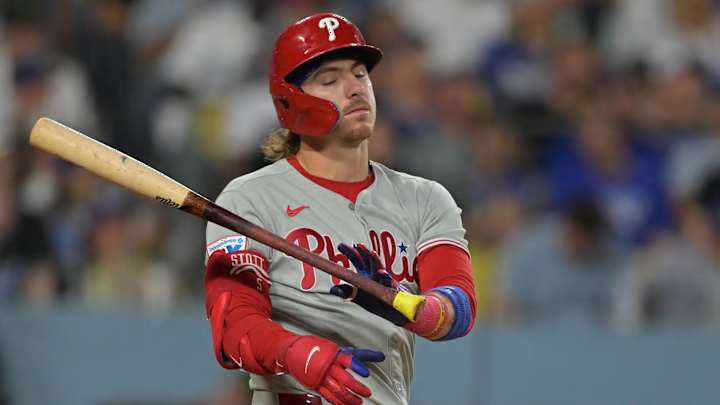
Current decisionmaker Dave Dombrowski put together a pennant-winning squad in 2022, headlined by outside offensive additions Bryce Harper, Kyle Schwarber, J.T. Realmuto and (wince) Nick Castellanos. The veteran baseball man complemented his new, expensive core with recent first-round picks Bryson Stott and Alec Bohm. Neither of them were any great shakes in 2022, but did enough to stabilize the bottom part of the lineup.
Unfortunately, the position player pipeline has all but dried up since Bohm and Stott came to the majors, and the Phillies haven’t had another homegrown hitter make any sort of impact in the ensuing seasons. Even those two have failed to live up to expectations, as Stott has posted an ugly .694 OPS over his five major league seasons, and Bohm has been thoroughly unimpressive outside of a fluke 2024 All-Star appearance, and has been the worst hitter in baseball to start the 2026 campaign.
What was once an experienced World Series-caliber core has devolved into a lethargic mess filled with bloated contracts. Harper and Schwarber are doing everything they can, but Realmuto is a shell of his former self, Castellanos was the instigator of a very public divorce with the team, and the ancillary pieces are a mixture of has-beens and spare parts. With no reinforcements coming from the farm, the Phillies lack the firepower to make any noise come playoff time.
Fans are hoping that a pair of recent first-round picks can solve that ever-present issue. 2023 top choice Aidan Miller has turned himself into a top-20 prospect in the sport, while 2022 17th-overall selection Justin Crawford debuted in centerfield this past Opening Day. To his credit, Crawford hasn't completely foundered in the bigs, posting a cromulent .247 batting average in his first 23 career games.
While that duo has displayed some signs of life, there are legitimate concerns surrounding both of them. Miller is staring down the barrel of a lost season, as he has yet to appear in a game due to a lingering back injury. Crawford’s complete lack of power could relegate him to Ben Revere 2.0 status. There are plenty of reasons for optimism, but neither guy is a lock.
Phillies fans have a lot to be grateful for in the midst of what is the third-most successful era in franchise history. Despite the lack of a World Series trophy, the team has been highly competitive for half a decade, and is still positioned to be in the playoff race for the next few seasons. Unfortunately, none of that success is due to an ability to develop position players, and it has put the team’s long-term future in jeopardy.
Without cheap, controllable offensive talent stepping up, the front office has continued to lean more heavily on aging free agent additions. These mercenary signings have yielded varying degrees of productivity, but one thing has been made clear: that’s no way to construct a roster.
If the Phillies plan on winning a championship anytime soon they’ll need to draft and develop the next wave of position player talent. Unfortunately, nothing about the team’s recent history gives much hope of that happening.
 Add us as a preferred source on Google