

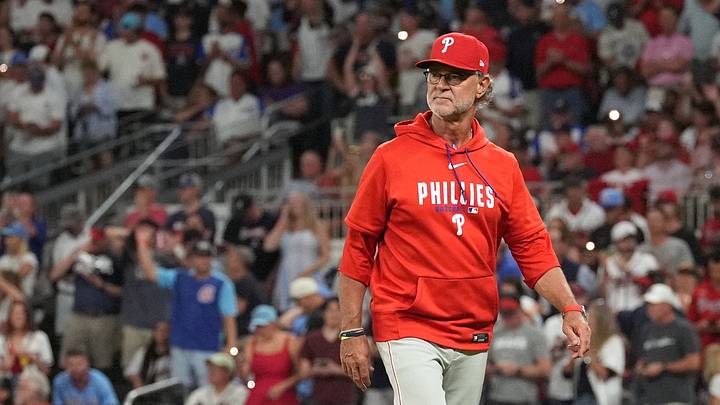
Philadelphia Phillies manager Don Mattingly came into a situation few skippers envy. When Rob Thomson was fired on April 28, the Phillies were 9-19 following an appalling start to the season.
President of baseball operations Dave Dombrowski hired Mattingly on January 5, 2026, ostensibly as the Phillies' bench coach, but also as insurance for Thomson. Since 2022, Mike Calitri had served as Thomson’s bench coach, but that off-season he accepted a new job with the Phillies as field coordinator.
That move allowed the Phillies to bring in a bench coach with extensive managerial experience in Mattingly, just in case they needed a change in the manager’s chair. So when Thomson was fired in late April, there was a ready-made replacement waiting in the wings.
Despite their pitiful record, it was clear, given their roster, that the Phillies were not a 52-win team (at a full-season pace). Sure, the team would rebound, but by enough to make the playoffs? That was uncertain.
Fangraphs had the Phillies’ playoff odds at 5.6% on that date. No team in MLB was lower. Philadelphia was aboard a sinking ship.
By May 18, the water had been bailed out of the boat. Mattingly had reeled off a 16-4 record immediately after taking over, putting the Phillies at 25-23 and right back in the playoff hunt.
Though the team didn't consistently reach the level of play that they did in early May, they played to their talent level the rest of the year. Whether Thomson’s firing or Mattingly’s hiring provided the spark, the team was electrified, and Mattingly deserves credit.
A sad end to the season shouldn't distract from a remarkable summer
By September, so many games had been played that the joy of that period had faded, but don’t be fooled into thinking time makes the achievement less remarkable.
Mattingly’s flaws were exposed as the season dragged on, even though it was easy during the honeymoon period to convince ourselves he was flawless. His overreliance on certain bullpen arms, namely Orion Kerkering and Johnathan Bowlan, meant they were gassed by the playoffs. Furthermore, Mattingly’s reluctance to start Zack Wheeler on short rest in Wild Card Series Game 3 may have cost the Phillies their season.
Yes, we can place some blame on Mattingly for these errors, but the players should take some of the criticism too. Aaron Nola had an uncharacteristically poor outing in that final playoff game; had he gotten through just three or four innings, we might be singing a different tune.
Brooks Raley and Kerkering should have been reliable bullpen options down the stretch. They went into July 31 with 1.96 and 2.61 ERAs, respectively. There was no reason to believe they would both melt down so spectacularly.
Given all that, it’s amazing the Phillies outperformed their run differential by such a large margin. Since they scored only 15 more runs than they allowed, the team was expected to finish 83-79. It’s to Mattingly’s credit that he got them to 88 wins with a bullpen constantly on the verge of meltdown and the worst offense in the sport by OPS+.
Now, with a coaching staff more to Mattingly’s choosing, his real test begins in 2027. With Carlos Mendoza and Peter Fatse in the clubhouse, there are no more excuses. Anything fewer than a playoff berth and several postseason series wins should be seen as a failure. Given their payroll, the Phillies have the horses to be a serious contender next year; it’s up to Mattingly to lead them to the promised land.
 Add us as a preferred source on Google