

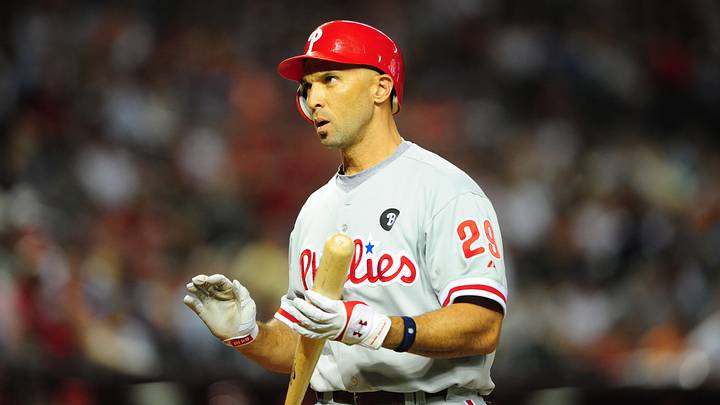
The Philadelphia Phillies are the losingest team in professional sports history. Their 11,464 defeats mark a franchise that played in the second division for nearly all of baseball’s history. Yet, they have had an outsized presence in end-of-season awards voting.
They have had five Managers of the Year, four Rookies of the Year, seven Cy Young Award winners, eight MVPs, 49 Gold Gloves, and 24 Silver Sluggers. For all that silverware, a bevy of Phillies have been passed over for the Louisville Slugger Silver Slugger Award since the honor's introduction in 1980.
You could make more than a dozen different cases for Phillies who deserved the award but were passed over for myriad reasons, from overreliance on counting stats to name recognition, playoff position, and more.
Among those cases, with the benefit of hindsight, it’s clear that 6 of those names rose above the rest.
These Phillies legends earned Silver Slugger hardware and received snubs
Bryce Harper - 2020
The most recent snub was Bryce Harper. In his 2020 season, he slashed .268/.420/.542, missing only two games in a COVID-shortened season. Outfield Silver Slugger winners Juan Soto and Ronald Acuña Jr. had better seasons—only marginally in Acuña’s case—but there’s very little that winner Mookie Betts did better than Harper.
Betts’ OPS and OPS+ were 35 and 11 points lower than Harper’s, respectively. Yes, Harper hit three fewer home runs and stole two fewer bases, but that doesn’t account for a chasm in their rate stats. If predictive metrics are more your cup of tea, then Harper’s .454 xwOBA laps the field over Betts’ .362 figure.
There’s no reason Harper’s trophy cabinet shouldn’t include a fourth Silver Slugger, except that he missed the playoffs and Mookie’s Dodgers didn't.
BRYCE 💣 #RingTheBell pic.twitter.com/DMA5dPuKKs
— Philadelphia Phillies (@Phillies) September 12, 2020
Jayson Werth - 2010
In 2010, Ryan Braun was in the midst of a run of five straight Silver Slugger Awards, but voter fatigue did Werth no favors. Milwaukee’s right fielder mashed 25 home runs and slashed .304/.365/.501, good for an .866 OPS, and it was that elusive plus-.300 batting average that probably did Werth in.
The Phillies’ right fielder had his best season in red pinstripes that year, with 27 home runs and a .921 OPS, 55 points higher than Braun. But advanced stats were not yet in vogue, and Braun’s higher batting average and 103 RBI to Werth’s 85 meant the award went the Brewers’ way.
Raúl Ibañez - 2009
It’s easy to forget just what a revelation Ibañez was upon his Phillies debut. Replacing the Phillies legend Pat Burrell in left field, Ibañez has an OPS of 1.048 through July 20. And though he cooled off as the dog days of summer encroached, he completed the campaign slashing .272/.347/.552 with an OPS+ of 132 and 34 home runs. It was the finest season of his career.
It makes no sense, then, that Andre Ethier was awarded one of three outfield Silver Sluggers when he slashed .272/.361/.508 with 31 home runs. Yes, he had 13 more RBI, but he wasn’t stealing bases at a higher clip, nor did the Phillies miss the postseason that year. The most likely explanation is that Ibanez missed two weeks in late June/early July, and that was enough to sway voters in the Los Angeles slugger’s favor.
Scott Rolen - 1998
There’s a straightforward explanation for third baseman Vinny Castilla’s Silver Slugger robbery over Rolen: the Coors Effect.
That year, Castilla hit 46 home runs with a .319/.362/.589 slash. In an era before park-neutral stats existed to compare players who played at high elevations, this must have seemed worlds better than Rolen’s .290/.391/.532 slash with only 31 home runs. But OPS+ cuts through the fluff.
Rolen’s 139 figure that year was far better than Castilla’s 127. We just hadn’t invented the tools to truly show how much of an impact playing in the footsteps of the Rocky Mountains has on a hitter.
John Kruk - 1993
It’s remarkable that career .300-hitter John Kruk never won a Silver Slugger. But based on his personality, you’d have to imagine he would be the type to not care.
Nevertheless, his 1993 season with the Whatever it Takes Dude Phillies was arguably the finest of his 10 years in MLB, and it went unrecognized. He hit .316/.430/.475 with 14 home runs and 85 RBI. That line pales in comparison with the gaudy numbers put up by Fred McGriff of the Atlanta Braves, whom the Phillies dispatched that season in the NLCS. He hit 37 home runs with 101 RBI, slashing .291/.375/.549 in an era when RBI mattered far more than OBP.
And though I’ve tried—and failed—to avoid using OPS+ to compare players in eras before the stat existed, Kruk did just edge out McGriff’s 144 total with a figure of 145. This would probably be a close race even today, but even if Kruk still lost, the race would be tighter than it was in 1993.
Lenny Dykstra - 1990
You would think that, in 1990, Dykstra’s .325 batting average would have led him to triumph over Bobby Bonilla’s .280 average. Alas, Bonilla’s prodigious 32 home runs and 120 RBI were too much for Dykstra’s respective 9 long balls and 60 RBI.
The Phillies’ center fielder led the league with a .418 OBP, and his OPS was 18 points higher than the Pittsburgh Pirates outfielder's. Dykstra stole 33 bases to Bonilla’s four, too. But as we established, voters in that era were more concerned with counting stats than they are today, and Dykstra would have to wait until 1993 to claim his first Silver Slugger Award.
Honorable mentions:
Carlos Ruiz, 2012, 2010; Chase Utley, 2010, 2005; Aaron Roward, 2007; Von Hayes, 1989; Gary Matthews, 1981
 Add us as a preferred source on Google