

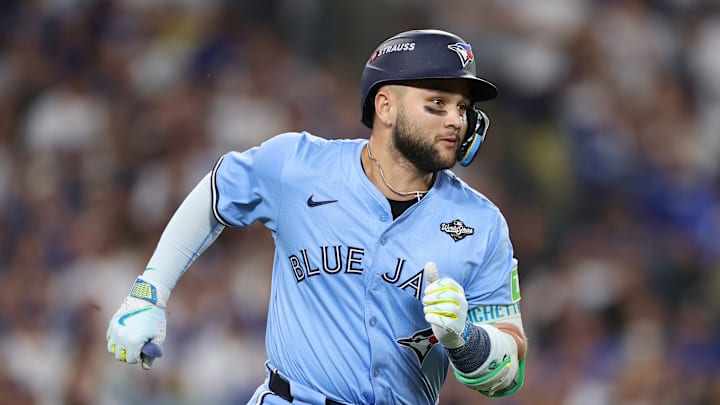
Just when it appeared the Philadelphia Phillies' focus for the rest of the offseason was primarily on addressing who their catcher will be this year, the opposite may be true. In recent days, rumors have surfaced that they are interested in signing Bo Bichette.
According to The Athletic's Matt Gelb and Ken Rosenthal, the club will be meeting with the infielder soon (subscription required), with a video conference scheduled for Monday.
They are by no means close to anything, but if the Phillies sign Bichette, the addition, while exciting for the team and fan base, will create some issues in 2026. There's no doubt that Bichette's bat would provide a boost to the Phillies' lineup despite concerns that he has dealt with numerous leg injuries in his career.
However, there's always a cost and adding Bichette would cause some other problems that the Phillies would have to address.
Here are 4 problems adding Bo Bichette would create for the Phillies heading into 2026
1. Signing Bo Bichette would cost more than just his annual salary
Adding Bichette wouldn't come cheaply. The Phillies would cross the fourth luxury tax threshold if they signed the infielder. They would need to pay double his salary this year. President of baseball operations Dave Dombrowski has said before that he and managing partner John Middleton don't want a $400 million payroll. While adding Bichette wouldn't bring the payroll that high, it would contradict their previous stance.
With a payroll currently sitting around $300 million, the Phillies are just $4 million shy of the highest threshold. Once they cross that, which adding Bichette would do easily, they would pay a 110 percent penalty on most of his salary. With a projected AAV coming in somewhere between $26 million and $30 million, Bichette would cost the Phillies much more than that in 2026.
The Phillies have much to consider regarding their payroll if they want to sign Bichette. The addition would mean they would have to pay a luxury tax penalty, something they have given the impression they would like to avoid.
2. Adding Bo Bichette would spell the end of J.T. Realmuto's tenure
Signing Bichette means the Phillies wouldn't be able to bring back J.T. Realmuto. Dombrowski would need to trade for a catcher or add a backstop in free agency. It would be a downgrade behind the plate, considering how good Realmuto still is at managing the pitching staff and controlling the running game.
The Phillies want Realmuto back, but he remains a free agent after they made a contract offer earlier in the offseason. The catcher appears not to be in a rush to sign a deal and is weighing his options.
While Bichette is better than Realmuto offensively, is the front office really ready to move on from the veteran backstop? If they add the infielder, the Phillies will have a new starting catcher this season.
3. They would have to move Alec Bohm, despite his low trade value, to make room for Bo Bichette
One of the players the Phillies avoided arbitration with recently is third baseman Alec Bohm, who will make $10.2 million in his last season before becoming eligible for free agency next winter.
If the Phillies sign Bichette, they would need to trade Bohm to clear his salary and make room on the infield. His trade value was already low at the beginning of the offseason, considering he regressed offensively last year from his 2023-2024 numbers.
Dombrowski overestimated Bohm's value last offseason when the infielder was in trade rumors. If the Phillies add Bichette, they will need to accept the best offer they can get for Bohm, which won't be substantial.
4. Putting Bo Bichette at second base would create a logjam on the infield
Second baseman Bryson Stott would have to move to third if the Phillies sign Bichette. Stott is a better defender than Bichette and would fit better at the hot corner despite only eight career games at third in the minors and two in the majors.
While Stott would adjust to playing third base, the hypothetical changes make it less likely that top prospect Aidan Miller would debut with the Phillies in 2026. There wouldn't be a spot for him with a healthy infield.
Currently, with Stott at second and Turner playing shortstop, third base looks like the position that Miller, a natural shortstop, could play depending on whether Bohm is traded. However, that will obviously change with Bichette.
Phillies fans would need to wait until 2027 to see Miller make his debut. While a full year in Triple-A Lehigh Valley wouldn't necessarily be a negative for the young infielder, it may be frustrating if he shows he is ready for the majors this season.
 Add us as a preferred source on Google