

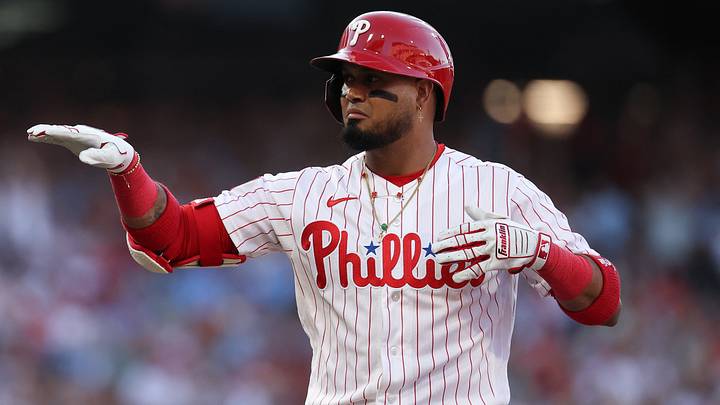
There is no one else in baseball quite like Luis Arraez. He has won three batting titles, and in 2023 he became the first player to win one in each league in consecutive seasons. Few hitters reach age 30 with such a decorated résumé. He does it with the slowest swing in the sport. When Statcast unveiled bat tracking in 2024, Arraez ranked dead last in bat speed among qualified hitters. What he lacks in speed, he makes up for with hand-eye coordination, pitch recognition, and bat control that rank among the best the modern game has seen.
He doesn't walk much, and he won't steal many bases, but in 2026 he added something that changed his market. After a winter when teams viewed him as a first baseman or DH, Arraez went back to second base and posted 12 Outs Above Average, a 97th-percentile mark. Value at a premium position is something teams pay big money for.
His numbers after the deadline were modest; he posted a .278/.309/.369 line in roughly 40 games before an ankle injury ended his season. What mattered more was what he did to the Phillies' roster.
His arrival sent Bryce Harper to right field and reshuffled the infield; the Phillies went 27-19 with him while scoring 4.87 runs per game, up from 4.31 before the trade. Arraez brought energy to the clubhouse, too, and for an aging roster, a player who lets others slide around the field and through the DH spot is worth a great deal.
How much Luis Arraez's next contract should cost the Phillies
Since Arraez was traded midseason, he wasn't eligible for a qualifying offer, so signing him won't cost draft picks. That widens his market and drives up his price. Keith Law of The Athletic ranked him fifth among free agents and projected a four-year deal worth north of $100 million, possibly approaching $120 million. ESPN's Kiley McDaniel landed at three years and $54 million, and MLB Trade Rumors projected three years at $48 million.
Players are mostly paid for what they've already done, and Arraez has been underpaid for years. He has earned roughly $46 million in his career. That's to be expected, given he's been under team control for a large part of his Major League career.
Looking forward, a safe projection has Arraez at a little under 3.0 WAR next season. At the going free-agent rate per win above replacement, that's worth somewhere in the $20 to $30 million range. Law's case is that Arraez will age well because his game doesn't depend on bat speed or foot speed, so figure another $20 to $30 million of value in year two and a $15 million to $25 million floor in year three. If the defensive gains hold, that number could climb even higher.
As a former Major League pitcher myself, I know what good bat control does to an inning. Making a good pitch and watching it get punched through a hole in the infield puts added stress on the pitcher. With Harper and Kyle Schwarber hitting behind Arraez, every single adds even greater tension. The payroll is already high, but with Harper and Schwarber in the back half of their primes, the Phillies' window is closing. The right fit for the Phillies counts for more than the biggest name on the open market, and two or three years of Arraez is exactly that.
 Add us as a preferred source on Google