

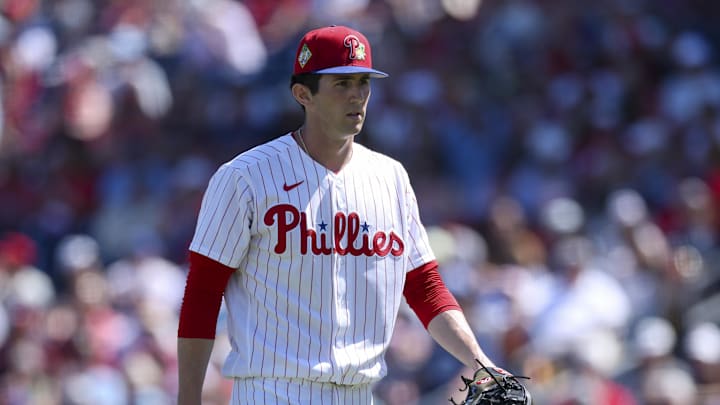
Andrew Painter had a good spring training for the Philadelphia Phillies. He finished with a 2.31 ERA, a 0.77 WHIP, eight strikeouts, and allowed three earned runs and two walks in 11 and 2/3 innings. Now, he'll turn to the regular season.
The anticipation for Painter's MLB debut season is off the charts. He struggled in the minors last year due to the arm placement of his fastball. The right-hander worked hard to fix and address the problem during the offseason. Based on his performances this spring, though, there is still reason to worry about his top pitch. Alarmist fans certainly aren't without merit.
Why Phillies fans should be concerned about the Andrew Painter fastball doomers
Painter was impressive during his first Grapefruit League game on March 1 against the New York Yankees. The average velocity of Painter's fastball was an impressive 96.8 mph. He didn't allow any hits, runs, or walks and had one strikeout in two innings. According to TJ Stats' Thomas Nestico, the shape of the Pompano Beach, Florida native's fastball was a concern, despite his apparent success. Also, the whiff rate on his four-seam fastball was a below-average 12.5 percent.
Andrew Painter fired off an efficient 3 innings against Toronto in his start today
— Thomas Nestico (@TJStats) March 7, 2026
The efficiency is nice, but it was accompanied by loud contact and an uninspiring shape on his fastball. Without its previous elite ride, I am bearish on Painter entering 2026. pic.twitter.com/8LPsVXCwpg
During his second appearance this spring on March 7, Painter allowed one hit and one walk in three innings versus the Toronto Blue Jays. The fastball was worse overall than his previous start against the Yankees because of the shape.
The velocity dipped to 96.3 percent, and Painter's whiff rate dropped further to 11.1 percent, which wasn't as concerning as other developing trends. His expected weighted on-base average on the four-seamer was 0.614, significantly worse in comparison to a solid 0.293 average against New York. The 22-year-old's zone percentage of 31.6 was significantly lower than the 53.8 percent he'd finished with previously.
Against the Baltimore Orioles on March 13, Painter allowed three runs during the top of the third inning, including a home run. The right-hander's fastball shape was improved from the Blue Jays game. However, the shape and velocity involved still aren't as good overall as they were before he had Tommy John surgery three years ago.
Painter's 16.7 percent whiff rate and expected on-base weighted average of 0.775 with the pitch weren't good. However, the zone percentage of 60.0 percent was substantially better compared to the start against the Blue Jays.
In Painter's final spring training game on March 18 versus the Atlanta Braves, his fastball started strong, but the same issues with location out of the strike zone, whiff rate, and expected on-base weight continued to hinder the talented young player's performance. However, he totaled three strikeouts in four innings, maintained consistent velocity on his four-seamer, and kept the Braves from scoring any runs.
Andrew Painter fired off his best start of the Spring with 3 K over 4 scoreless innings
— Thomas Nestico (@TJStats) March 18, 2026
His fastball started off strong once again before tailing off in the 4th inning with significantly less ride -- a common trend this Spring. On the other hand, the secondaries look great! pic.twitter.com/QkGFB6qkLm
Painter has ongoing issues with the top pitch he uses, which remain rightly concerning only days before the start of the regular season. Fans should be at least somewhat worried about his fastball. He still could get the four-seamer back to where it was in 2021-22, but that'll take some time. Meanwhile, the advanced statistics don't lie. It'll be interesting to see how many innings he pitches in the first few starts of his MLB career, and if he has more difficulty the longer he's in a game.
 Add us as a preferred source on Google