

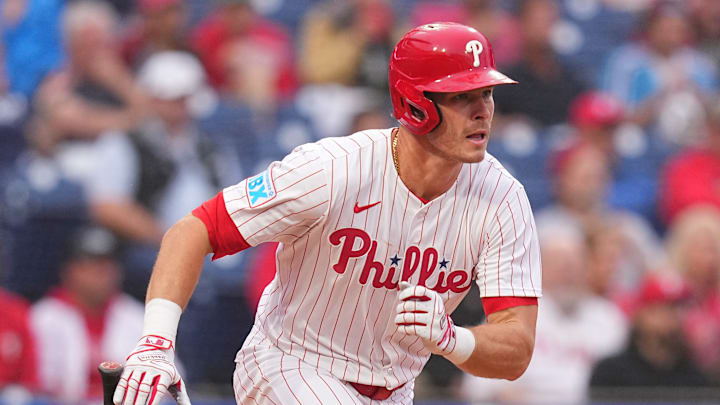
When the Philadelphia Phillies signed Max Kepler this offseason to a one-year, $10 million deal, the expectations and reception from the fans were tepid. He was coming off a season where he played just 105 games and slashed .253/.302/.380 with a career low eight home runs and the second-lowest OPS of his career at .682.
The Phillies front office did their scouting and saw some of his past seasons where he hit 20, 24 and 26 home runs with an OPS of .727, .855, and .816, respectively, and thought the risk-reward was worth it. Could Kepler come to Philadelphia and the hitter friendly ballpark and rekindle some of his past glory?
Well, on the surface so far in the 2025 season, the 32-year-old veteran’s numbers are nothing to write home about. On the year, through 43 games, he is hitting .218/.301/.374 with just five home runs, eight doubles, and 15 RBIs. His .675 OPS would be his third lowest of his 11-year career. He has registered a 21.7 percent strikeout rate and a 9.6 percent walk rate, which both are just about league average.
After a home run in his Phillies home debut, it’s been a slower start to the season than the Phillies front office and Kepler had wanted or imagined.
Underlying numbers show it’s not time to panic about Max Kepler just yet
Yes, on the surface, the numbers aren’t pretty. But baseball is a fickle sport, and sometimes the ball doesn’t bounce the hitter's way, or the batter just runs into some bad luck. When you dive in deeper to Kepler’s underlying numbers and advanced statistics, they tell a vastly different story.
Referencing FanGraphs’ Statcast numbers, Kepler is making barrel contact at a 10.7 percent rate and has a 49.1 percent hard-hit rate. If the season ended today, his barrel rate would rank as the second highest in his career, only behind his career year in 2023 when he had a 12.2 percent rate. The rate this year is a substantial improvement compared to his 6.2 percent barrel rate last season.
Likewise, if the season ended today, his hard-hit rate would be his career high at 49.5 percent. Besides his current career high of 47.6 percent in 2023, he has hovered in the high 30s and low 40s. Last season, he ended the year with a 36.6 percent rate.
According to Baseball Savant, so far in 2025, Kepler’s barrel rate ranks in the 62nd percentile in the league and his hard-hit rate ranks in the 82nd percentile. Just from these numbers alone, you’d expect Kepler’s numbers to be a lot more attractive.
Max Kepler's expected stats show how unlucky he has been this season
Even more evidence of Kepler’s unfortunate luck is his expected batting average (xBA), his expected slugging percentage (xSLG) and his batting average on balls in play (BABIP).
His .254 xBA is 36 points higher than his actual batting average of .218. His .438 xSLG is 64 points higher than his actual SLG of .374. His .252 BABIP would be on the lower end of his career and slightly below his career average of .257.
For reference, the league average BABIP is .290 with the highest being set by Freddie Freeman at .411. Not coincidently, Freeman’s batting average is one of the top averages in baseball and his xBA is actually lower than his actual average, batting .375 with an xBA of .321.
Like it or not, luck absolutely plays a part in baseball and overall statistics, but looking at the underlying numbers tell the real story. The Phillies organization and the fans shouldn’t be worried about Kepler’s production just yet. As the weather warms up, and as long as the veteran left fielder continues hitting the ball hard, eventually he will find open grass and the numbers will improve.
Time will tell if the reward was worth the risk with Max Kepler.
More Phillies from That Ball's Outta Here
 Add us as a preferred source on Google