

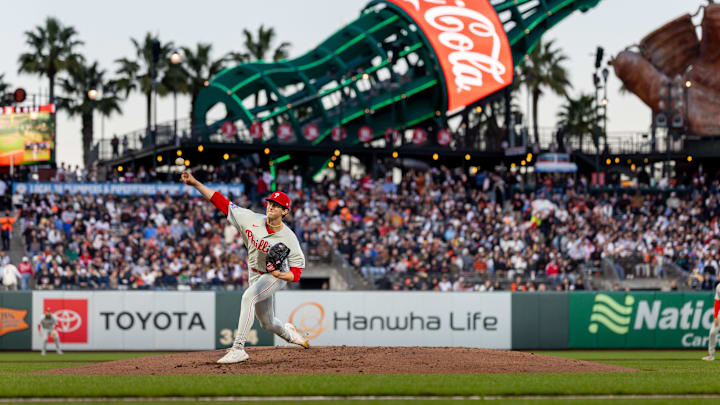
Andrew Painter dominated in his highly anticipated MLB debut, shutting down the Washington Nationals over 5 1/3 by allowing just one run while striking out eight. It was a sight for sore eyes, and one that promised better time ahead for a rotation that lost Ranger Suárez over the offseason.
Unfortunately, he wasn't able to keep that momentum rolling into his second start, as a struggling San Francisco Giants lineup rocked him to the tune of nine hits and four runs over four innings. He wasn't able to fool hitters at all during the outing, forcing him to battle through all 90 of his pitches.
Andrer Painter struggled in his 2nd career start, allowing 9 H and 4 ER while striking out just 1
— Thomas Nestico (@TJStats) April 7, 2026
His typically dominant breaking balls could not fool Giants hitters as they teed off against his fastballs. Lowering his fastball usage will likely be a talking point this year pic.twitter.com/Pp7wW3Gbie
Luckily, the Phillies' dormant offense woke up in the seventh inning, claiming a lead the bullpen wouldn't relinquish. Still, the team needs Painter to be better moving forward if they hope to defend their back-to-back NL East titles.
Andrew Painter's second MLB start provides reason for caution after electrifying Phillies debut
There were some unfortunate moments, like when Heliot Ramos blooped a soft single into center field for a run in the third inning. But there were also crucial mistakes, like when Luis Arraez hammered a hanging slider 363 feet that would have been a home run in nearly any other park (or if it were hit by nearly any other batter).
It was a Matt Chapman triple off a poorly located curveball that did the bulk of the damage on his final line, as Painter clearly didn't have the same stuff he did against Washington. Both of his primary fastballs (his four-seamer and his sinker) flashed below-average tjStuff+ figures, hence why hitters were able to punish them for wOBA totals over .330.
His sinker, in particular, is worth highlighting from the outing. Painter had a doozy of a time locating the pitch, only throwing it in the zone 29.2% of the time. Hitters did chase it outside the zone 10 times, but it's hard to not to run that number up when the pitch is never being thrown for a strike.
Both his slider and his sweeper were more effective, but the same command issues reared their ugly heads on those offerings as well. Perhaps he could get away with the wildness if hitters were swinging and missing more, but Painter's 15.7% whiff rate through two starts is among the worst in the sport this year.
Really, the takeaway here is that Painter is learning what all rookies do: MLB players are the best in the world. You're not going to have your best stuff every start, but the best pitchers have enough tools in their arsenal to get around any shortcomings. It's part of the learning curve to have growing pains like this.
Painter's next start is slated for the weekend against the Arizona Diamondbacks. He's facing a little pressure with Zack Wheeler gearing up for a return, but if he can string together a few strong outings from here, he'll be in a far safer position than the thin ice Taijuan Walker is currently walking on.
 Add us as a preferred source on Google