

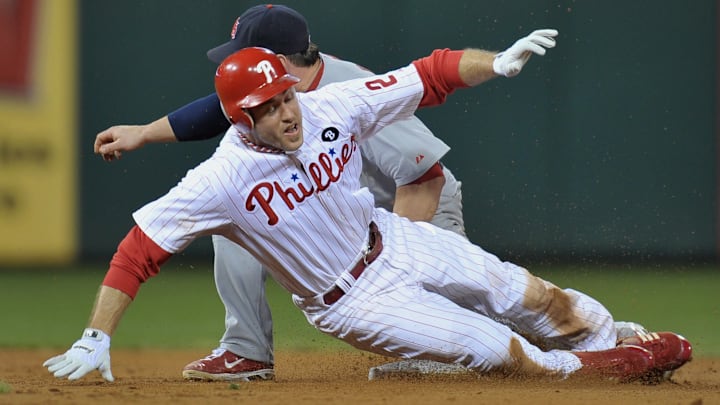
The Philadelphia Phillies seemingly didn’t have a stake in the game during the Hall of Fame’s recent Contemporary Baseball Era Committee election. Of the eight eligible players, only Dale Murphy (who played for the Phils from 1990 to 1992) and Fernando Valenzuela (1994) had any ties to the organization whatsoever.
But the result of said election, which saw Jeff Kent emerge as the only player to cross the threshold for entrance into the Hall, has an even deeper impact for the Phillies. That’s because, if Jeff Kent is a member of the National Baseball Hall of Fame, how can you possibly keep Chase Utley out of Cooperstown?
Phillies legend Chase Utley's Hall of Fame chances look even better after Jeff Kent’s selection to Cooperstown
Kent’s list of accomplishments is an impressive one, to be sure. With 351 career home runs as a second baseman (out of 377 total), he is the all-time leader at the position. Throw in nearly 2,500 hits and a solid .290 career batting average, and Kent fits neatly in 19th place in career bWAR among second basemen and 22nd in JAWS, an advanced stat that compares a player’s career and peak WAR totals among Hall of Famers at his position to act as the de facto gold standard for Hall entrance.
The vast majority of second basemen ahead of Kent in both WAR and JAWS are no-doubt-about-it Hall of Famers, and even some of the players behind him are enshrined as well. With that, it has to be stated that Kent is looking up at Utley in both columns, as Utley sits 15th in WAR and 12th in JAWS. In fact, the JAWS measurement tool says that not only is Utley better than Kent, but also other recent inductees at the position like Roberto Alomar and Craig Biggio.
Back to actual counting stats that might be easier to understand. It's true that Kent holds an edge over Utley in categories such as homers, hits, RBIs, and runs scored. Those raw totals can’t be ignored, nor can the MVP that Kent garnered in 2000 before his teammate Barry Bonds rattled off four straight BALCO-aided victories. But it’s Utley's peak that sets him apart.
From 2005 to 2009, Utley produced five consecutive seasons that were arguably better (and actually are better, according to WAR totals) than any season Kent ever had, even his MVP campaign. Utley finished between seventh and 14th in MVP voting in all five years, capturing four Silver Sluggers and making four All-Star appearances during that time.
You can say that Kent was objectively excellent during two seasons of his career, 2000 and 2002, but nothing else that he produced rivals what Utley did over the aforementioned five seasons.
Kent logged his best years after the age of 30; meanwhile, Utley broke down accordingly and saw a decline once he hit that age. Various ailments throughout his 30s are really the only thing working against Utley at this point; otherwise he would have easily eclipsed 300 home runs and 2,000 hits and may have been a first-ballot Hall of Famer. Credit to Kent for possessing the kind of longevity that Utley did not, but there isn’t much doubt about who the better baseball player was when given an extended period of time at the height of their abilities.
You can even point to areas such as Utley having a lower strikeout rate than Kent, a higher walk rate, and more of a willingness to “wear it” for his team, as he sports a 204-125 edge in being hit by pitches. Utley was also a superior baserunner, which isn’t just about being fast, although that can help. It all speaks to baseball IQ, which Kent had but which set Utley apart from everyone.
The bottom line is that Kent was only denied induction for so long because of his proximity to Barry Bonds and the many clouds of suspicion that still swirl around that era of Major League Baseball. Kent also spent time with six different teams, and the Hall seems less likely to enshrine such “vagabond” players. Put Kent on the Mets or Dodgers (two teams he did play for) for most or all of his career with those numbers, and he is a slam dunk. In general, the Hall loves players with strong ties to a single club, and that will only help Utley’s case.
Putting a timeline on things, Utley has gone from 28.8 percent on the writers ballot in his first year of eligibility up to 39.8 percent in his second year. Given the fact that there are no new “wow” candidates on the ballot this year, with Utley’s former teammate Cole Hamels perhaps having the strongest case among newcomers, Utley is poised to make a sizable leap this time around. He won’t hit the 75 percent threshold for induction in 2026, but 2027 is in play, 2028 is likely, and 2029 is a virtual guarantee if he hasn’t made it by then.
Kent, Alomar, Biggio, and Ryne Sandberg are the only four second basemen whose careers started after 1968 who have been elected to the Hall of Fame, and Utley looks well positioned to make it a party of five sometime this decade. Phillies fans wouldn’t normally care either way about a player like Kent gaining admission to the Hall of Fame, but in this case it all but assures that Phillies Nation will be sojourning to Cooperstown soon to see Utley take his place among the greats.
 Add us as a preferred source on Google