

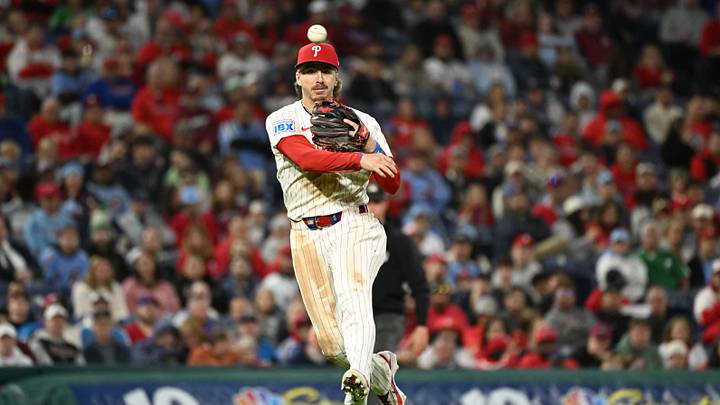
The Philadelphia Phillies 2026 infield was defined by change. The trade for Luis Arraez upended the status quo, sending Bryce Harper to the outfield, Alec Bohm across the diamond, and Bryson Stott from second to third base. Now, with Bohm and Arraez hitting free agency, Dave Dombrowski will be tasked with rebuilding the unit once again.
The first of several obvious moves will be Harper moving back to first base. The Phillies will then have a chance to add a better hitter to the lineup in right field, with Seiya Suzuki or even possibly Teruaki Sato as potential targets.
Unfortunately, the free-agent market at the hot corner leaves a lot to be desired. Bohm is among the best of the bunch, which raises the question of whether or not his brief but hot October showing was enough for Philadelphia to ignore signs of his decline.
The Phillies can't afford to sign up for another sub-.700 OPS year with bad defense to boot, so banking on Bohm bouncing back wastes one of the prime opportunities to upgrade the roster. On a macro level, the club needs more right-handed balance added to the lineup. The most productive bats—Kyle Schwarber and Bryce Harper—hit from the left side.
As a team, the Phillies ranked 15th in batting average against southpaws, at .241. More holistically, their .705 team OPS against lefties ranked 16th. Not terrible, but not exactly needle-moving either, especially for a squad with World Series aspirations.
To level up, Philadelphia could look to the trade market, and one possible solution is Texas Rangers third baseman Josh Jung. The 28-year-old righty hit .299/.365/.462 with 12 homers over 104 games in 2026. Jung won't come cheap, though, and the Phillies would be looking at giving up Bryson Stott, plus a mid-tier prospect, for his services.
Phillies moving Bryson Stott for Josh Jung would open up a return for Luis Arraez
First, let's tackle this from the Rangers' perspective. They want to compete in a wide-open AL West, so why would they trade a productive player like Jung? Texas's president of baseball operations, Chris Young, said the team's goal is to get "younger, more athletic, and more dynamic." They have top prospect Sebastian Walcott (No. 8 on MLB Pipeline's top 100) ready to take over for Jung, and a hole at second base where Stott could slide in while also adding to the club's athleticism.
The Phillies would upgrade Bohm at the hot corner, save money in arbitration, and gain an additional year of team control in a Jung-for-Stott swap. Jung would also instantly become the best right-handed hitter on the team, and his .366/.448/.545 line against lefties in 2026 would add the balance Philadelphia seeks to the lineup.
Jungster gets us started! #AllForTX pic.twitter.com/JaEQ0K15Z2
— Texas Rangers (@Rangers) September 19, 2026
Of course, trading Stott for Jung simply takes the hole at third base and moves it to second. That's where reuniting with Luis Arraez comes in.
The Arraez experience didn't quite meet expectations: the three-time batting champ hit just .278 in a Phillies uniform and suffered a late-season ankle sprain that kept him off the playoff roster. Still, the sample wasn't large enough to write him off, especially given his track record of contact excellence.
There are moving parts here, but if the Phillies were to pull this off, it would give them a far more productive infield. Adding two contact-oriented hitters, Jung and Arraez, would complement the power that Harper and Kyle Schwarber bring.
Losing Stott's defense and baserunning would be a bitter pill to swallow, but if it yields a more balanced, productive lineup, Dombrowski should seriously consider it. The Phillies can't go into another season with such a feast-or-famine lineup. That strategy has been foiled enough times in the postseason since 2024.
 Add us as a preferred source on Google