

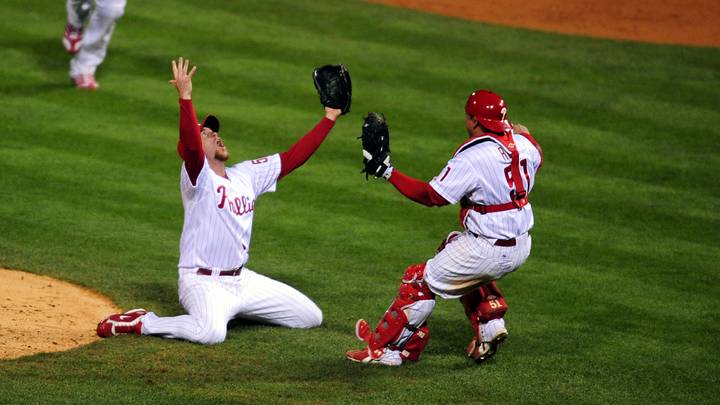
The final out call echoed around sports bars and through taxis driving down Broad Street. The cacophony from the stadium roared through South Philadelphia. Hundreds of thousands of revelers ran out of their homes and into the streets to celebrate.
After 28 years, finally, a championship for the Philadelphia Phillies.
Following two rain-soaked days, the clouds had receded over Philadelphia, and a brisk autumn chill filled the air. No one would call it baseball weather, but it was enough to resume the suspended Game 5 of the 2008 World Series.
After 48 hours of furious water-cooler and sports-radio debate, Phillies manager Charlie Manuel chose 11-year MLB veteran Geoff Jenkins to lead off the bottom of the 6th, pinch-hitting for Cole Hamels.
In the final plate appearance of his career, Jenkins had the biggest clutch hit of his life, roping an outside fastball to the power alley in right-center, where it bounded off the warning track and the wall. Jenkins rumbled around second, then turned back and returned to the bag. He clapped his hands and pumped his fist. The Phillies were in the driver’s seat.
Jayson Werth drove him in as the go-ahead run two batters later, but a Rocco Baldelli solo shot off Ryan Madson in the top of the seventh knotted the score at 3-3.
Maligned all series, Pat Burrell saved the day in the bottom of the seventh
So it came down to Pat Burrell leading off the bottom of the seventh, hitless all series, in what everyone knew would be the final game of the nine-year Phillie’s career.
Burrell rocked a curveball off lefty J.P. Howell. On a warmer night, the ball would’ve left the yard. Alas, it was 44 degrees and windy.
The hit went off the top of the wall at what would one day become Monty’s Angle. A faster runner might have had a triple as the baseball careened into unoccupied center field, but 32-year-old Burrell was never fleet of foot, even in his younger days.
So, after finally snapping his cold streak, Burrell was lifted for pinch-runner Eric Bruntlett, who had scored the winning run in the bottom of the ninth in Game 3. And four days later, history repeated itself when Pedro Feliz singled up the middle through a drawn-in infield to drive in the go-ahead run. With J.C. Romero and Brad Lidge next out of the bullpen, it was all the Phillies needed.
Romero retired the side in the top of the eighth on just 12 pitches, celebrating wildly as he came off the mound. Then it was Lidge, in the midst of one of baseball’s all-time great redemption arcs after blowing Game 5 of the 2005 NLCS.
He was 47-for-47 in save opportunities, owner of a 1.95 ERA in the regular season and a 1.08 ERA in the postseason.
Lidge got Evan Longoria to pop up to shallow center, where Chase Utley coolly sat under the ball. One out.
Next was catcher Dioner Navarro. His broken-bat flare to right field dropped in the grass in front of Werth, putting the tying run aboard.
After him was super utility man and future 2016 World Series hero Ben Zobrist, with Fernando Perez running for Navarro at first base. The crowd grew nervous; Philadelphia had endured too much disappointment between 1980 and 2008.
Perez stole second on a 1-1 slider, and it felt as if the air inside the ballpark had become thick. But Lidge remained poised on the mound and retired Zobrist on a screaming line drive to right field. Werth had been positioned perfectly. Two outs.
The atmosphere in the ballpark grew to a frenzy as the Phillies gathered for a conference on the mound: Pedro Feliz, Jimmy Rollins, Chase Utley, Ryan Howard, Carlos Ruiz, and pitching coach Rich Dubee.
Eric Hinske, who had hit a pinch-hit home run in Game 4 three nights earlier, strode to the plate.
Pitch one was a slider chopped just foul up the first-base line. Strike one.
Lidge cupped his hand in front of his mouth, trying to warm up his fingers in the frigid October temperatures. He started in at Hinske. Pitch two was a slider that fell below the plate; Hinske tried to check his swing and failed. Strike two.
The noise of nearly 46,000 faithful packed into Citizens Bank Park grew to a crescendo. Lidge checked the runner, then threw his best pitch: a slider that started over the outer half, cut back through the heart of the plate, and finished below the zone.
Hinske swung and missed. The ballgame and the Series were over.
Lidge jumped in the air and landed on his knees, embraced by Ruiz, who sprinted from behind home plate. Howard, weighing 250 pounds, arrived next and tackled both the pitcher and the catcher as the team piled on top of them.
For one glorious night, the city of Philadelphia fell into ecstasy. After 28 years, the wait was over.
 Add us as a preferred source on Google