

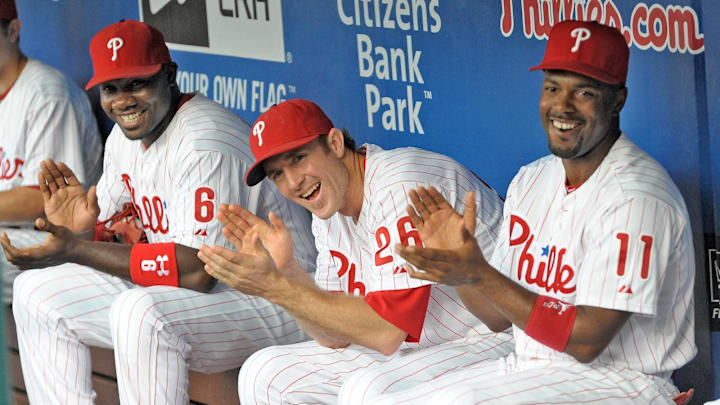
Long ago, many years before these players defined Philadelphia sports history, they sat on the bench in the home dugout at Citizens Bank Park and learned to play alongside the greats who came before. However, they are now household names across the greater Philadelphia area.
The Philadelphia Phillies have been fortunate to have a myriad of strong prospects come through their pipeline, but only a select few had what it took to become superstars. There were also the talents the Phillies acquired along the way. Players who, while they weren't "homegrown," certainly made their mark on the Phillies.
While the content isn't as redialy avaliable as one would hope, Baseball America still provides subscribers with access to scouting reports of players new and old, and we thought it would be fun to dig up the past and see the humble beginnings of some of the team's modern greats.
Here's a look back at the humble beginnings of some modern Phillies legends
Chase Utley
It should come as no surprise that Chase Utley is at the top of this list. A soon-to-be Hall of Famer, Utley was one of the most consistent prospects in the Phillies' system after he was drafted 15th overall from UCLA. He was no stranger to praise from Baseball America after being a 2003 Baseball America Second Team Minor League All-Star, batting .319 in Triple-A with 11 home runs in 67 games before his call-up later that year.
Scouting report: Utley's early Baseball America scouting reports highlight his potential as a pure hitter (subscription required), with some of his best assets being his legitimate power and his consistency at the plate. His 2000 draft report noted that defenses have put a "Ted Williams shift" on him. As a college athlete hoping to make it in the bigs, one of the highest honors would be getting measured against one of the greatest hitters in baseball history, and Utley was one of the best college prospects in the MLB Draft that year.
The one concern scouts seemed to have was Utley's defensive range in the middle infield, with several scouts asking where he could comfortably fit on the diamond and play long-term. By 2003, scouts admitted that with hard work Utley could be an average defender at either second or third.
Career results: Utley is one of, if not the most well-known Phillies of this generation. Our parents had Mike Schmidt, our grandparents had Richie Ashburn, and us? We get the gritty, hard-working, determined leader of the infield.
While the scouts were spot on with how well Utley could hit, as he hit a grand slam in his first major league at-bat against the Rockies. In his career, he hit .276 with 259 home runs, was hit by 204 pitches, still tops in team history, and had 1,885 hits in 1,937 games over his 16 seasons. He was one of the most clutch hitters in Phillies history and leads all second basemen in franchise history with the single-season records for most doubles (48 in 2007), home runs (33 in 2008), and RBIs (105 in 2005).
Utley stole 154 bases and was caught just 22 times, and that elite baseball IQ also equated to an elite, premier defensive second baseman, arguably the best in franchise history. From 2005 to 2010, Utley consistently ranked among the top players in defensive runs saved and defensive WAR, making him one of the most consistently reliable defensive second basemen throughout the 2000s and 2010s until his retirement.
Jimmy Rollins
Where Utley is, Jimmy Rollins is not far behind, both on the diamond and off. He solidified himself as a Phillies icon from his very first at-bat, when he roped a triple down the right-field line at Veterans Stadium. He spent 15 out of his 17 seasons in Philadelphia as the leader of the Phillies' infield and every season in fans' hearts.
Scouting report: Baseball America's scouting reports on J-Roll, of course, highlighted his exceptional defense, speed, and intelligence (subscription required), with his 1996 draft report calling him a dynamo at the plate with excellent hand-eye coordination. Scouts noted Rollins' shorter stature and questioned his offensive production, saying he'd have fringe or below-average power and would need to rely on his knowledge of the game and his speed. While his height was still of note in his 2000 preseason scouting report, Rollins was equally efficient from both sides of the plate and had the skills of bigger players.
Career results: The switch-hitting shortstop went on to become the all-time Phillies hits leader, finishing his tenure in Philadelphia with 2,306 hits, breaking Schmidt's previous record. He's also first in franchise history in doubles (479) and at-bats (8,628) and ranks third all-time in triples (111) and runs (1,325).
In 2007, Rollins won NL MVP, a Silver Slugger Award, and the first of four Gold Gloves. He was honored with the 2014 Roberto Clemente Award. There's no real way to describe how much Rollins means to the Philadelphia sports community, as well as the nation, after playing for Team USA.
While his Hall of Fame case isn't as definitive as his longtime double play partner Utley, Rollins' career, specifically his career in Philadelphia, deserves to be immortalized in Cooperstown, just as he was honored as a member of the Phillies Wall of Fame.
Ryan Howard
Known as one of the franchise's greatest sluggers and a cornerstone of the Phillies, Ryan Howard is the last piece of the Phillies' infield holy trinity. Howard spent his entire career with the Phillies and is widely considered the greatest first baseman in franchise history.
Scouting report: According to Baseball America, there was never denying The Big Piece's raw power (subscription required), with his 2001 draft report saying he resembled a young Frank Thomas. However, there were consistent concerns with his high strikeout rate and his vulnerability to off-speed pitches. Howard's all-or-nothing swing, while generating power, also equated to contact issues, as noted in both 2001 and his 2004 preseason scouting report.
Scouts also noted an average defender who moved well for his size and had good instincts at first. But both reports consistently referred to a deep analysis of his hitting metrics, his patience and maturity at the plate, and how Howard probably had a "bad case of draftitis," which equated to a terrible draft stock.
Career results: Howard, at least at the plate, exceeded expectations and defied criticism of his high strikeout rate (he had a career 31.5 percent strikeout rate). It was his Achilles heel in later years. However, there is no denying that Howard is one of, if not the best, power hitters in Phillies history.
He was exceptional at the dish, especially in his prime. Howard hit 58 home runs in his 2006 MVP season, had four consecutive years of 45+ home runs, and was the fastest player in all MLB history to reach 100 and 200 home runs.
Howard was a three-time All-Star, a Silver Slugger, and an instrumental part of the 2008 World Series run. You can now make the argument that Howard is one of the best power hitters of his generation. While he might not make the Hall of Fame, like Frank Thomas, anyone who had the pleasure of watching Howard in his prime knows that he has just as much power in his bat as The Big Hurt.
Cole Hamels
The most anticipated Phillies prospect of the early 2000s was none other than Cole "Hollywood" Hamels. After being the unsung anchor of the team's pitching rotation during the Phillies' most successful era, he is another household name anywhere East of the Susquehanna River. As one of the newest NBC Sports Philadelphia broadcasters, he clearly remains a beloved figure, providing insightful analysis alongside Tom McCarthy.
Scouting report: Much like how fans feel about Hamels, scouts agreed in his 2002 draft report that his story was a feel-good one (subscription required) after the southpaw broke the humerus in his throwing arm as a high school sophomore and missed all of his junior year. Still, after gushing about his command, they noted that clubs should be wary of investing in Hamels with a first-round pick because of his medical history.
However, in his 2006 preseason scouting report, scouts noted that he had fully recovered from his injury and that the Phillies got him for a steal in the 2002 Draft when he fell to 17th overall. They highlighted his striking out the fearsome duo of Derek Jeter and Alex Rodriguez in spring training. Durability was still a primary concern, though, with myriad injuries plaguing his early rise through the minors. Even after that, scouts still called Hamels a top-of-the-rotation starter.
Career results: While Hamels might not be as well known as Sandy Koufax and won't be inducted into the Hall of Fame as quickly as fellow lefty CC Sabathia, his career can easily be defined by one thing that scouts continuously doubted him on: durability. After debuting in 2006, Hamels went on to have a stellar decade in Philadelphia and played his final MLB game in 2020 before retiring in 2023.
During his tenure with the Phillies, Hamels became one of the most reliable fixtures in the team's rotation. For over nine consecutive seasons, Hamels made 30+ starts, and in 10 seasons with the Phillies, he posted a 3.30 ERA over 1,930 innings, with 1,844 strikeouts. Hamels finished his time in Philadelphia ranked third in strikeouts behind Steve Carlton and Robin Roberts and had 114 wins, the sixth-most in Phillies history.
Hamels, as many know, was the NLCS and World Series MVP in the Phillies' legendary 2008 championship run. He was a key contributor, going 4-0 with a 1.80 ERA that postseason, notably after starting both the opening and clinching games of the 2008 NLCS. Just a year after he retired, the Phillies honored Hamels, signing him to a one-day contract so he could officially retire as a Phillie.
Roy Halladay
While he didn't start his career in Reading or Scranton/Wilkes-Barre, Roy Halladay certainly made an impact on the Phillies organization in the final four seasons of his career. After spending the first 12 years of his career with the Toronto Blue Jays, Halladay left his mark on Philadelphia, from his perfect game to his final pitch, he was nothing short of the ultimate workhorse with some of the most dominant stuff of that era.
Scouting report: Baseball America's 1995 draft report for Halladay (subscription required) was straightforward. It touched on his height, his average fastball with good arm action, and the fact that he was projected to go in the second round. In 1998, they mentioned Halladay having two shutouts in 1997 and the fact that he was a true athlete. All of his pitches, including his fastball, had improved, and scouts projected he would likely start the 1998 season in Triple-A and that he would spend the whole season there unless he could get a better grip on his knuckle-curve.
Career results: There is no one way to summarize Halladay's career. He was one of the best pitchers to ever throw a baseball, who absolutely left the Phillies organization, and this world, too soon.
Halladay changed the Phillies' pitching staff, transforming the starting rotation into a powerhouse. The "Ace of Spades" in the "Four Aces," it's no secret that he delivered immediately with his Cy Young-winning 2010 season, his first season in the National League. That year, Halladay threw a perfect game and topped it with a no-hitter in the NLDS and continued to succeed, leading the club to a franchise-high 102 wins in 2011.
By the time Halladay retired, he had finished his career with 203 wins, a 3.38 ERA, and 2,117 strikeouts. He was inducted into the Hall of Fame posthumously in 2019 without hesitation. Known for his preparation before each start, "Doc" was known for his focus and quiet professionalism. After retiring in 2013, Halladay was quickly hired by the Phillies coaching staff as a mental skills coach and instructor.
Cliff Lee
Another Phillies ace who didn't start his career with the team, Cliff Lee spent the peak of his career in Philadelphia. The reliable southpaw was drafted in the fourth round by the Montreal Expos in 2000 and traded to the Cleveland Indians in 2002. Once he came to Philadelphia in 2009, however, Lee found his home.
Scouting report: In Lee's 2000 draft report, scouts immediately picked up on his erratic behavior on the mound (subscription required), despite his raw talent ranking third in the country. Even then, his fastball was unhittable, but he had a habit of losing his command after one pass through the lineup.
Once in the Guardians system, scouts noted that the Expos considered him one of the best pitchers in the 2000 Draft. Lee continued to show precisely why but still had some command issues at the beginning of the 2002 season, as noted in his preseason scouting report. But scouts also noted his continued progression and his natural talent, despite calling him a middle-of-the-rotation starter.
Career results: While Lee's split Philadelphia tenure might have been eclipsed by Halladay's, there is no denying that Lee went on to be one of the greatest pitchers of the 2000s. With time, he gained more control over the offspeed pitches, and despite a tragic ending to his career, Lee was a certified ace.
Leading the American League in BB/9 four separate times, his quick attack and reluctance to walk batters helped not just the Phillies but also the Texas Rangers to the World Series in consecutive years (2009 and 2010).
With the Phillies, Lee was an instant ace, coming off his 2008 Cy Young season. He immediately went 7-4 for the Phillies in 2009, with a 3.39 ERA in just 12 regular season starts. In the postseason that year he went 4-0 with a 1.56 ERA in five starts, including two complete games (one of which was in the World Series), before becoming part of one of the most controversial trades in Phillies history to make room for Halladay. After stopping in the AL West for a brief moment, Lee returned to the Phillies in 2011, where he played the final four years of his career.
Bryce Harper
Despite not having spent every summer of his early career in "Clearwooder," as Bryce Harper lovingly has coined the Phillies' spring training hub, there will never be a list of all-time Phillies without the likes of MV3. Since coming to the Phillies in 2019, Harper has carried the city of Philadelphia on his shoulder and has worn the city's blue-collar charm with pride. However, the now 33-year-old father of four is still searching for his first championship ring as the centerpiece of the roster.
Scouting report: From Harper's first draft report in 2010 (subscription required), his historic rise to the majors was well documented. He skipped out on the last two years of high school to enroll in a wood-bat junior college league. At just 17 years old, Harper hit .417/.509/.917. As mentioned in his 2012 preseason scouting report, Harper became one of the most hyped position-player prospects in baseball history and exceeded expectations throughout the Washington Nationals farm system.
His incredible strength and hands were mentioned in both his 2010 and 2012 draft reports, and despite not hitting left-handed pitching well in Double-A, he fought for a spot in spring training and debuted in 2012. Harper, despite training with the Phillies' farm teams, was at this time widely discussed and seen as the target of Phillies pitchers' ire. However, for baseball fans across the globe, Harper's journey to the majors remains one of the best success stories of baseball's early 2010s.
Career results: While Harper's career, more specifically his career in Philadelphia, is far from over, he's no longer manning the outfield, switching to play first base after returning from Tommy John surgery in 2022. Wherever he plays, he has been a transformative figure in Phillies history.
He already has a Hall of Fame-caliber tenure, complete with a 2021 NL MVP campaign (as well as a 2015 MVP campaign with the Nationals) and the 2022 NLCS MVP after hitting the famous Game 5 home run against the San Diego Padres. He has maintained a postseason OPS over 1.000 for Philadelphia and continues to show his pop at the plate. He enters 2026 with a career .280/.387/.519 slash line, 363 home runs, and 1,051 RBIs in 1,785 games.
While people have questioned his "elite level" status, he has continuously shown up both on the field and off. He has a career .905 OPS (.912 with the Phillies). Even though he hasn't been as consistent as he once was, Harper reignited interest in Phillies baseball. He changed the image of what it means to play in Philadelphia, mended the hope of die-hard fans, and re-engaged a younger generation to take an interest, all while being the embodiment of what it means to be a Phillies.
 Add us as a preferred source on Google