

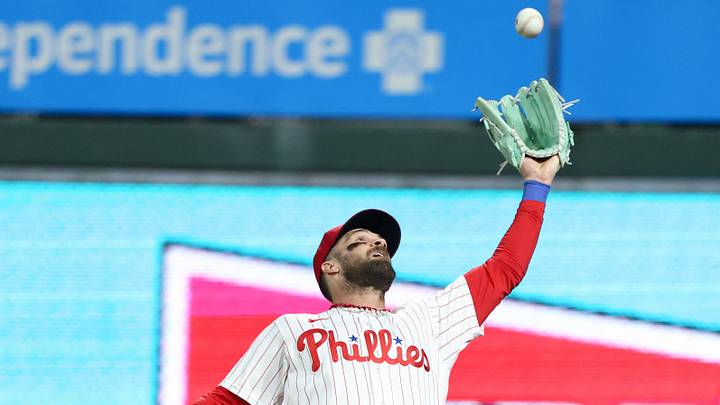
The Philadelphia Phillies' decision to shuffle their defensive alignment to slot in Luis Arraez at the trade deadline raised some eyebrows. There were a few questionable parts of the equation, but by far the most worrisome part was moving Bryce Harper back to the outfield.
Not only does conventional wisdom say that moving aging players to first base is the best way (aside from DH) to hide their glove and ease the workload on their bodies, but news came out that playing the outfield was making Harper's knee act up.
In fact, it seemed unnecessary to move Harper, given that the only reason that was necessary was to accommodate Alec Bohm and his basically replacement-level performance. It seemed that the smarter play would have been to leave well enough alone regarding Harper and plant Bohm on the bench.
However, legendary first baseman Joey Votto fired off a tweet storm recently that will have you rethinking the defensive value of first base forever. On top of that, it perfectly explains why moving Harper to the outfield wasn't such a bad idea after all.
2. The average baserunner is getting to first in 4–4.5 seconds in the major leagues. It’s not important to go get the ball as a first baseman as much as it is to catch everything while remaining on the base.
— Joey Votto (@JoeyVotto) August 19, 2026
Votto's talking about the value of receiving the baseball on throws in the infield. When you really start to think about it, the vast majority of plays in the infield end with the first baseman touching the ball, so it's easy to see how important his ability to receive the ball can be.
Votto mentions picks and tags on errant throws, as well as being a "big target" for the infielders, similar to a tight end serving as a quarterback's security blanket. He illuminates the last point further, and it really hammers the point home.
4. The great plays may not happen for the infield nearly as often. The diving, ranging, off-balance plays typically result in a non-ideal throwing position. This is where a good receiving first baseman makes all the difference. “Throw it over here and I’ll catch it.”
— Joey Votto (@JoeyVotto) August 19, 2026
Going back to the tight end analogy for a second, a quarterback, ironically, is more accurate when he has confidence that his receivers will catch anything he throws their way. When he doesn't have that confidence, the throws become more errant.
The same is true for infielders. If they know as long as they get it near the bag, the first baseman is going to come up with the ball, no matter if he needs to pick it out of the dirt or jump and come back down on the base.
That impact extends to points before the throw, too. If an infielder needs to make a diving, lunging, or jumping play, they're more likely to corral the ball if they're not worried about having to make a picture-perfect throw before even catching the ball.
It's a bunch of tiny little things that come together to make everything sync up... or not, if you have a first baseman who doesn't pull his weight as a receiver.
So where did Harper rank among qualified first basemen? Of the 35 men manning the cold corner, he ranked dead last with -8 first base receiving outs above average.
Bryce Harper playing the outfield might be a net positive for the Phillies defense
By putting Harper in right field, he now only impacts plays where the ball is actually hit at him, instead of having some role in the vast majority of all balls hit in the infield. By that logic, it's actually easier to hide him defensively in right than it was at first.
Defense has been an issue for Philadelphia this season, and at the time of the Arraez trade, the club ranked 21st in outs above average with -12. Now, as of August 27, they have improved to 19th with a -11 OAA mark.
It's hard to isolate how much of that is due to Harper moving versus how much a myriad of other factors have impacted the metric, but it's hard to deny that there's a clear break point from the Phillies' defense declining to this marginal improvement over the past few weeks.
Additionally, in an admittedly small sample, Harper hasn't actually been all that bad in right. He's logged 150 innings there, posting -1 OAA, coming in positive with 1 defensive run saved.
On top of that, Harper, Bohm, and Bryson Stott have all been red hot at the plate since the game of musical chairs. That's likely coincidental, but it at least proves that the unease of switching positions midseason hasn't carried over to their performance at the plate.
Bryce Harper as a Right Fielder:
— Fuzzy (@fuzzyfromyt) August 27, 2026
.351-BA/1.046-OPS
Bryson Stott as a Third Baseman:
.343-BA/.926-OPS
Alec Bohm as a First Baseman:
.341-BA/.948-OPS
Not sure we have ever seen something like this before lol just insane
Ultimately, we might come to find that the decision to move Harperwasn't as dangerous as we were led to believe. In fact, it may very well prove to be a major positive for the Phillies. At the very least, we can now say that we see the method behind the madness.
 Add us as a preferred source on Google