

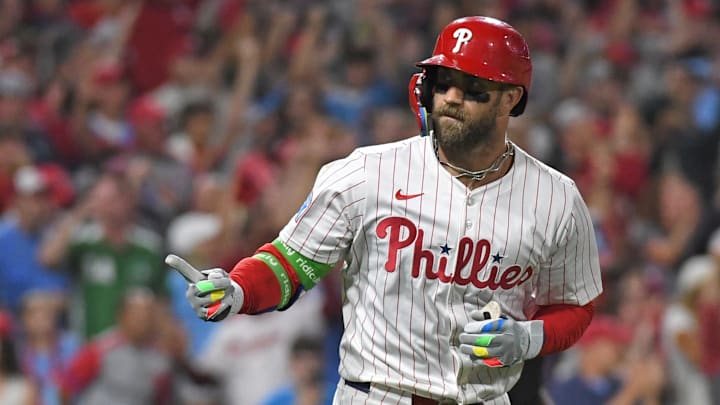
Much was made of Philadelphia Phillies president Dave Dombrowski’s comment this offseason about Bryce Harper not being “elite” when referring to his 2025 campaign. It even appeared to ruffle Harper himself. But even though the comment was blown out of proportion, it did stoke some fires about the debate surrounding Harper’s greatness, perceived or not.
Now is an interesting time to examine Harper, because we are at the exact point in time where he has played as many seasons with the Washington Nationals as he has with the Phillies, seven apiece. He is actually still sitting at 69 more games played with Washington than with Philadelphia, but that can be explained entirely by the fiasco of a 2020 season that was shortened from 162 games down to 60.
So, right off the bat, let’s lay any claims of Harper breaking down physically to bed. Despite a few notable health issues, he has been at the same level of health and availability during his age 26-32 seasons with the Phillies as he was from ages 19-25 in Washington. That, in and of itself, is a good sign. And the numbers reflect just as favorably on him from there.
Bryce Harper’s 14-year career split between Phillies and Nationals has been a model of consistency
Bryce Harper had an all-timer season for the Nationals in 2015, claiming his first MVP while posting a ridiculous 9.7 bWAR. It stands as his greatest all-around campaign, and it came at the age of 22. But when we rank the rest of his seasons by the same bWAR metric, it’s interesting to note that they fluctuate between his younger version with Washington and the slightly older model with the Phillies.
Age 22 is tops on his list as mentioned, and then the next seven of his seasons ranked by bWAR are ages 28, 19, 31, 24, 26, 20, 30. He won Rookie of the Year at age 19, and then he won MVPs six years apart for two different teams.
We aren’t talking about someone whose greatness was just concentrated in some five-year span before he slowly tapered off, but a much more prolonged peak. Harper has had some lesser seasons by his standards, but he always follows them up with a display of his true ability, showcasing a drive to always prove himself and shut up his detractors.
Harper sported an excellent .279/.388/.512 slash line during his Nationals career, and he’s followed that up by going .281/.386/.526 with the Phillies so far. He has built up such a large sample that we know his baseline and can spot when he deviates.
So, yes, his .261/.357/.487 mark in 2025 was subpar for him. Another such season would indicate a trend, but we should always be hesitant to write off a player of Harper’s caliber as “merely good” until they show us that they are no longer capable of repeating previous accomplishments.
In terms of counting stats, Harper has more RBIs and more steals as a Phillie than as a National, and he’ll need just six more home runs and 44 more hits to put his Phillies marks ahead in those categories, as well.
He strikes out a little more and walks a little less now than he did before he arrived in Philadelphia, but the numbers aren’t so different that they should cause any alarm. A tipping point will likely occur sometime in the future because it does for almost everyone, but it doesn’t appear imminent.
Stat | PHI | WSH |
|---|---|---|
Age | 26-32 | 19-25 |
G | 858 | 927 |
AB | 3,129 | 3,306 |
H | 879 | 922 |
2B | 218 | 183 |
HR | 179 | 184 |
RBI | 530 | 521 |
BB | 520 | 585 |
K | 820 | 834 |
AVG/OBP/SLG | .281/.386/.526 | .279/.388/.512 |
Simply put, Harper has been a nearly identical player as a Phillie that he was with the Nationals, which is exactly what the team signed up for when they brought him to town seven years ago. Not only that, but Harper’s expanded opportunities to play in the postseason have seen him hit .311 with 12 home runs and a 1.090 OPS in 38 playoff games with the Phillies after he had a somewhat disappointing showing in 19 playoff games in Washington.
The big moments have been there. This is precisely what the team signed him for.
Except...
A World Series trophy remains elusive. It’s the only empty spot on Harper’s ledger, and his legacy — the way he’ll be remembered among Phillies fans in perpetuity — hinges considerably on this. It will be the difference between him being a slam dunk on the proverbial Phillies Mount Rushmore or any mention of his greatness always having to field a "Yes, but…" response.
One thing that a title won’t affect, though, is Harper’s Hall of Fame case. Given the way that voting is now trending, he is probably already in, even if he never plays another game. But he will continue to compile for several more years, strengthening his case, and we’ll see him in Cooperstown sometime late next decade. His high-level consistent play has already assured that, and the only remaining question is whether he’ll be a first-ballot selection or not.
 Add us as a preferred source on Google