

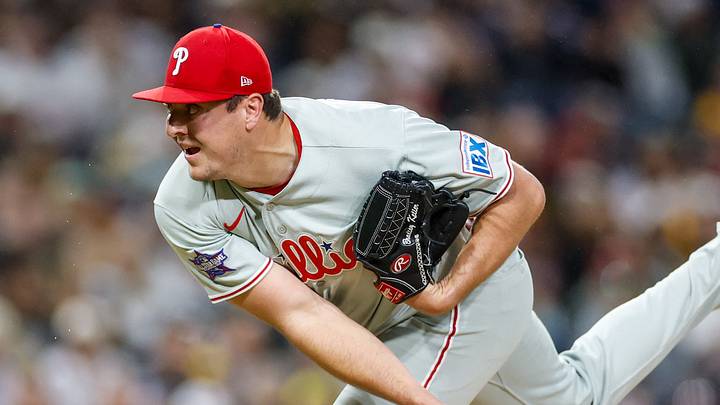
Anyone who watched the Philadelphia Phillies this past season knows they need bullpen help. The free agent market is the most obvious place to go shopping, and not for bargain-bin pickups like Jordan Romano. Relievers always carry risk, but the Phillies can’t let the failed Brad Keller experiment scare them away from spending more money to fix their relief corps.
Phillies president of baseball operations Dave Dombrowski has a type. Or at least he did before last winter. Dombrowski’s preferred method of adding to the bullpen in free agency was by handing out one-year “prove-it” deals to veterans. Unfortunately, few have worked out. Corey Knebel, Jeurys Familia, Craig Kimbrel, Joe Ross, and Romano all flopped after receiving one-year pacts from the Phillies.
Dombrowski attempted to end the constant churn of arms with a two-year, $22 million contract for Keller last offseason. At the time, it seemed like a safe option. The longtime starting pitcher had transitioned to a full-time relief role in 2025 to great effect, firing 69 ⅔ innings of 2.07 ERA ball with the Chicago Cubs. Before that, Keller hadn’t posted a sub-4.00 ERA since the pandemic-shortened 2020 season, but there was hope the role change had unlocked a new form for the right-hander.
Well, that didn’t happen. Keller wasn’t a complete flop when he took the mound for the Phillies, but his 4.02 ERA across 32 games was a far cry from his lights-out performance the year before. Worse yet, the 31-year-old started experiencing forearm tendinitis in mid-June, and after one July appearance, he underwent Tommy John surgery, ending his season and sidelining him for most, if not all, of 2027.
That bad luck coincided with just about everything else going wrong for the Phillies’ bullpen in 2026. Flamethrower José Alvarado barely kept his ERA under 6.00, soft-tosser Tanner Banks was so bad he got demoted to Triple-A, and the mercurial Orion Kerkering did nothing to dispel the sentiment that he crumbles under pressure en route to a demotion of his own. With Keller out of the picture, stalwart closer Jhoan Duran, setup man "Big" John Bowlan, and dynamite rookie Alex McFarlane became skipper Don Mattingly’s only trustworthy options.
Despite the Brad Keller backfire, the Phillies need to spend money this winter to clear up their murky bullpen picture
The Phillies don’t have a very clear picture of their bullpen at the moment. Beyond Duran, McFarlane, and Bowlan, they don't really have late-inning options. Trade acquisition Caleb Kilian appeared in only four games before going down for the year with an oblique injury, so he’ll most likely get the chance to prove himself in 2027. Journeyman southpaw Tim Mayza was already re-upped on a one-year contract, giving Mattingly at least one solid lefty.
Outside of that group, there are a lot of question marks. Will Kerkering get another chance in Philadelphia after two consecutive season-ending meltdowns? Can a 35-year-old Tanner Banks be trusted to turn things around? Are Chase Shugart, Kyle Backhus, Max Lazar, and spare parts good enough to round out the last few spots in the pen?
The answer to that last question, obviously, is no. There’s nothing wrong with stockpiling depth, but devoting multiple bullpen spots to underwhelming arms is a recipe for disaster. The Phillies need to bring in at least one (but hopefully two or three) dependable options this winter. Luckily, plenty of quality hurlers are available. All-Star lefty Adrián Morejón is the belle of the free-agent ball, but he’ll likely command a hefty contract over four or five seasons, and he has a qualifying offer attached. He’d make for an incredible one-two punch alongside Duran, but Dombrowski has already telegraphed a desire to keep spending in check.
Aside from Morejón, there are loads of well-established arms like David Bednar, Raisel Iglesias, Alex Vesia, Bryan Abreu, and others. It’s hard to imagine any of that bunch settling for a cheap one-year deal. With that in mind, the Phillies still need to pony up to bring in one or two reliable arms to form a steadfast bridge to Duran.
Something in the Keller range of two years, $22 million, or perhaps a bit more, should be able to entice someone from that bunch to sign on the dotted line. It's understandable for Dombrowski and company to be gun-shy given the disaster the Keller signing became, but they can’t let that hold them back from addressing the biggest weakness of an aging team that has World Series aspirations.
 Add us as a preferred source on Google