

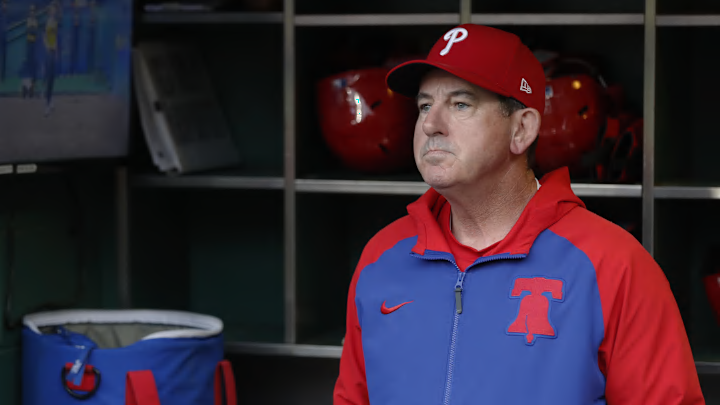
Rob Thomson’s firing was never going to be a one-office cleanout. Especially not for a Phillies organization trying to bring a $300 million roster back to life before the season drifts too far into crisis mode. Once Don Mattingly moved from bench coach to interim manager, the rest of the staff had to shift with him. Now the ripple has reached Triple-A Lehigh Valley, where Chris “Tank” Adamson is taking over as Lehigh Valley IronPigs manager after Anthony Contreras was promoted to the Philadelphia Phillies’ major-league staff as third-base coach.
On the surface, this is standard organizational housekeeping. The Phillies fired Thomson after a brutal 9-19 start, elevated Mattingly, moved Dusty Wathan from third-base coach to bench coach, and promoted Contreras from Triple-A Lehigh Valley to fill the third-base coaching job.
Once Contreras left the IronPigs, someone had to manage the club. Adamson, who had already been serving as Lehigh Valley’s bench coach, was the logical next man up. The IronPigs announced him as the seventh manager in franchise history, with his first game on April 28 against Syracuse.
But let’s not pretend this is just moving nameplates around.
Phillies’ coaching shuffle shows Rob Thomson fallout is already bigger than one firing
The Phillies disrupted the chain of command from the major-league dugout down to their top minor-league affiliate. These secondary moves show what actually happens when a contender hits the panic button. Everyone below the blast zone has to adjust.
Contreras had returned in 2026 for his fifth season managing the IronPigs, making him the longest-tenured manager in franchise history after already becoming the club’s winningest manager last season. That’s continuity that matters in Triple-A, where the job is about development, communication, rehab management, emergency depth preparation and, in Philadelphia’s case, keeping the next wave ready for a big-league team that suddenly looks a lot less stable than expected.
Adamson’s promotion is worth paying attention to. The Phillies clearly wanted continuity, not a total scramble. Adamson already knew the rhythms of the clubhouse and the players bouncing between Lehigh Valley and Philadelphia. Choosing the familiar voice in Triple-A was the sensible play.
This is what happens when a team built to win now starts playing like a team searching for answers. The Phillies fired Thomson because a supposed National League heavyweight stumbled out of the gate badly enough that the organization decided patience had expired. And now we get the awkward truth: the Phillies are trying to sell stability through a series of destabilizing moves.
For Adamson, he knows the assignment. Keep the pipeline functioning. Keep prospects and depth pieces steady. And make sure Lehigh Valley doesn’t become collateral damage in Philadelphia’s big-league reset.
 Add us as a preferred source on Google