

The 2008 World Series is the high-water mark in most living Philadelphia Phillies fans' memories. A core of Ryan Howard, Chase Utley, Jimmy Rollins, and Cole Hamels delivered the city its second championship in franchise history.
The architect of that club, Pat Gillick, retired after that magical season and handed the reins to young Rubén Amaro Jr., with the opportunity to capture another title or two. Unfortunately, Amaro’s reign didn’t yield the desired results, and he became a reviled figure in the city. On this day, 17 years ago, his tenure began.
Rubén Amaro Jr. is Phillies royalty. His father, Rubén Amaro Sr., was a Gold Glove second baseman for the Phils back in the 1960s, and remained with the franchise as a coach for the 1980 World Series-winning club. During that historic era, Amaro Jr. got his start with the Phillies, serving as the team’s batboy for four seasons. Amaro Jr. graduated from William Penn Charter School and won a College World Series with the Stanford Cardinals in 1987.
His professional career began that same year when he was selected in the 11th round of the draft by the Los Angeles Angels. He made his big-league debut in 1991 with the Halos, but was traded to the Phillies the following offseason (alongside Kyle Abbott) in exchange for Von Hayes.
Amaro Jr. spent the next two years in his hometown, appearing in 151 games with the Phillies, slashing .232/.314/.367, and playing a depth role for the pennant-winning 1993 team. He was dealt to the Cleveland Indians in exchange for Heathcliff Slocumb in the winter of 1993. He played only 54 games during his two-year run in Cleveland, but he earned a spot on the Tribe’s World Series roster in 1995.
After being cut by the Indians, Amaro bounced around a bit before landing back in Philly in the latter part of the 1996 season. He spent the next three campaigns with the team, making his way into 270 games with a .246/.312/.341 line. And with that, his Major League career drew to a close.
Amaro Jr. landed on his feet after retiring as a player, transitioning directly into a front office role with the Phillies. He would spend the next decade as an assistant general manager, first under Ed Wade and then under the Hall of Famer Gillick. Amaro was tapped to succeed Gillick following the 2008 World Series victory, and he inherited largely the same roster that had won it all.
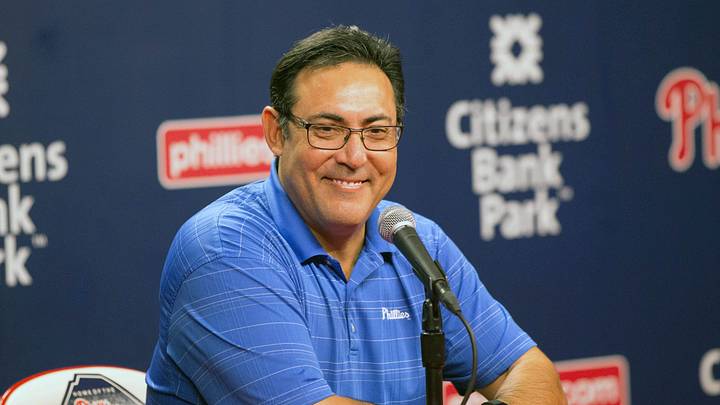
17 years ago today, Rubén Amaro Jr.'s long history with the Phillies culminated in a promotion to general manager
Outfield stalwart Pat Burrell departed in free agency, and one of Amaro’s first moves as GM was signing veteran Raúl Ibañez to fill the void. The addition of Ibañez, who earned his only All-Star selection in 2009 at the age of 37, as well as dynamite rookie J.A. Happ and trade deadline acquisition Cliff Lee, propelled the Phils to another National League pennant and a trip to the World Series. Unfortunately, they fell just short to a stacked New York Yankees club in their quest to repeat as champions.
Amaro loaded up once more for the 2010 season, reeling in future Hall of Fame hurler Roy Halladay in a steal of a trade with the Toronto Blue Jays (at the expense of trading away Lee), brought back old friend Plácido Polanco to man third base, and made another deadline blockbuster for ace Roy Oswalt to form a juggernaut starting rotation. Regrettably, the Phils ran into the eventual World Series champion San Francisco Giants in the Championship Series.
2011 was the greatest iteration of the Amaro-era Phillies, as he managed to lure Cliff Lee back in free agency, beating out higher-dollar offers from other clubs. On top of that, rookie starter Vance Worley was the best back-end starter in the league, while another deadline mega-deal brought All-Star Hunter Pence over from the Houston Astros to play right field. Yet again, the Phils delivered diminishing returns. 102 wins in the regular season led to a heartbreaking five-game Division Series loss against the St. Louis Cardinals, who went on to win it all.
Then the fall began.
Age and injuries caught up with the Phillies’ core in 2012, leading to an 81-81 season that ended without a playoff berth for the first time since 2006. The following two years were even worse, with identical 73-89 marks, before the team completely bottomed out at 63-99 in 2015. Those dreadful seasons saw franchise legends Utley, Rollins, Hamels, Halladay, and others play their final games with the team.
Amaro Jr. was dismissed in September of 2015, with his team on its way to the worst record in the sport and a barren farm system. The fanbase was delighted to see the once-beloved figure walk the plank. He had become known as “Ruin Tomorrow Jr.”
What would have been a sad ending to a decades-long relationship between the Amaro family and the Phillies didn't end there. Amaro Jr. spent the next three seasons coaching with the Boston Red Sox and New York Mets before rekindling his relationship with the Phils.
In 2020, he was hired by NBC Sports Philadelphia as a studio analyst and part-time color commentator, and he remains in those roles today. Additionally, he co-hosts the podcast The Phillies Show with Todd Zolecki and Jim Salisbury.
Despite all of Amaro Jr.'s flaws as an executive, his dedication to the franchise cannot be questioned. He grew up here, played here, retired here, and remains here. His doomed tenure as general manager may have started 17 years ago today, but his roots in the city and with the franchise started decades before that.
 Add us as a preferred source on Google