

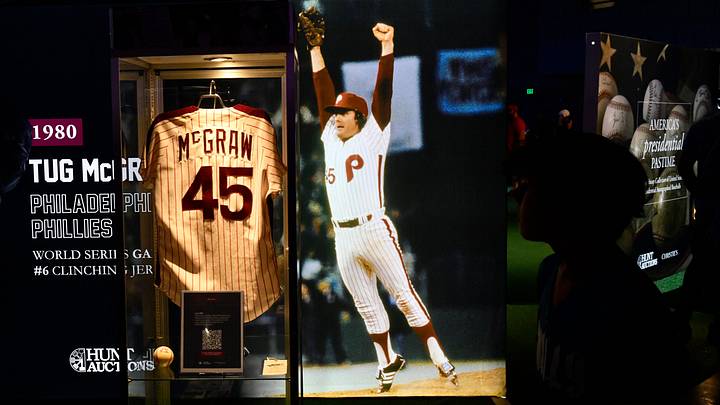
Tug McGraw is widely regarded as the best closer in Philadelphia Phillies franchise history, and he still may not get the flowers he deserves. He arrived from the New York Mets in a deal that sent Don Hahn and Dave Schneck to Queens. At age 30, on the heels of two bad seasons, McGraw reinvented himself, became the National League’s premier closer, and cemented his place in club history.
But it was on this date, November 8, in 1984, that McGraw was granted free agency and subsequently announced his retirement later that winter.
It had been coming for a long time. McGraw’s workload had fallen off dramatically since 1980, when he threw 264 pitches in a single postseason over 14 days. “My arm was dead, baby,” he said years later, recalling the end of that run.
By 1982, McGraw had moved into a setup role, and when the Phillies acquired Al Holland from the San Francisco Giants that offseason, “Tugger” relinquished the role for good. He didn’t appear once in the playoffs during the 1983 World Series run.
Tug McGraw was an outsized character out the field, too
McGraw’s excellence on the mound is only a small part of his story. He was an outsized figure, a character on and off the field. He appeared as himself in a 1999 episode of Everybody Loves Raymond and ran a nationally syndicated comic strip in the mid-70s called Scroogie, about a relief pitcher for a fictional team called the “Pets.”
As McGraw’s baseball career faded into the rearview, he reconnected with his estranged son, Tim, from a previous relationship, financed his college education, and became involved in his life. In 1990, McGraw bought his son a van so he could tour with his band.
You may recognize some of his music. Today, Tim McGraw has over 10 million monthly listeners and 49 number-one country chart hits.
McGraw has been inducted into both the Mets Hall of Fame and the Phillies Wall of Fame. He’s the only player who is honored as such by both clubs.
After a fight with brain cancer in 2003, McGraw passed away in 2004. He had reconnected with his estranged son and became a legend for two franchises. Tim’s 2004 hit "Live Like You Were Dying" was recorded in his father’s memory, and the music video featured footage of the final out of the 1980 World Series.
Several years later, Tim spread a handful of his father’s ashes on the mound before throwing out the first pitch during Game 3 of the 2008 World Series.
A part of McGraw’s “Ya gotta believe!” spirit lives on at Citizens Bank Park today.
"He had that sincere enthusiasm, like a little boy out there," said former Phillies chairman Bill Giles. "For him, every game was like a 12-year-old hitting a grand slam home run. The way he went about everything he did, even the way he walked in from the bullpen, was different than the normal relief pitcher."
 Add us as a preferred source on Google