

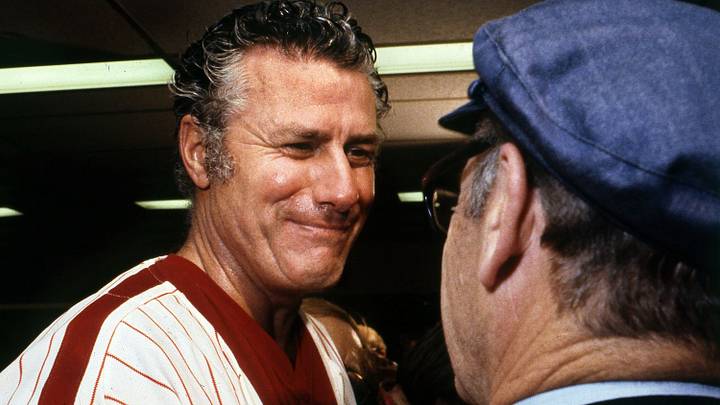
The 1980 Philadelphia Phillies were a team fueled by disappointment. They had lost three consecutive National League Championship Series from 1976-78 after setting franchise win-total records in the former two years. Signing future MLB hit king Pete Rose to a then-record free-agent contract only worsened the downward spiral, and the Phillies finished 4th in the NL East in 1979.
But 46 years ago today, on October 12, 1980, Philadelphia finally had the disasters of the past wiped away.
Going into that 1980 NLCS, Phillies fans then felt much as supporters of today’s team do. There was a general anathema about the team. They had failed to deliver so many times before.
They lost the NLCS on a walk-off bunt to the 102-win Cincinnati Reds in 1976 (the only NLCS, besides 2026, played between two teams with 100 or more wins). They had lost Black Friday NLCS Game 3 in 1977 to the Los Angeles Dodgers when closer Gene Garber gave up three runs in the top of the ninth at Veterans Stadium, surrendering the lead and the game. They had lost to the Dodgers again in 1978, this time in Los Angeles, when Garry Maddox dropped a fly ball in center field with two outs in the 10th inning, and a walk-off single scored the series-winning run just two pitches later.
The Phillies of that era were labeled chokers, and they had given fans every reason to believe it would happen again.
So when the 1980 version of the squad fell behind 2-1 to the Houston Astros, with the final two games to be played at the Astrodome, Philadelphians wrote the team off. The Phillies took Game 1 behind a masterful performance from Steve Carlton, then lost Games 2 and 3 in extra innings after bullpen meltdowns. The offense simply couldn't support masterful starting pitching, but after taking Game 4 when the Astros’ own bullpen melted down in extra innings, the stage was set for an all-time matchup in Game 5.
The Astros, looking for their first-ever pennant, sent 14-year Major League veteran Nolan Ryan to the mound. The Phillies, looking to advance to the World Series for the first time in 30 years, sent National League Pitcher of the Month in September, Marty Bystrom, to the mound—he had started only five Major League games.
Broadcaster Andy Musser commented, “If anything works in Marty Bystrom’s favor, it’s just that he doesn’t know what’s going on down there.”
How perrenial chokers finally won the big one
The Astros struck first off Bystrom just five batters into the game to take a one-run lead, but Astros manager Bill Virdon opted not to intentionally walk Bob Boone in the bottom of the second with two outs, runners on second and third, and Bystrom on deck. Boone slashed a single up the middle to give the Phillies a 2-1 lead.
Years later, in a documentary on the 1980 team, Phillies' former owner Ruly Carpenter said, “I often wondered, if that managerial decision was made by a Philadelphia manager, and you’d ended up losing the game, that manager might as well pack his bags and leave town.”
That was the negative tenor surrounding the Phillies at the time.
But the Phillies held onto the lead. In the third inning, Astros shortstop Craig Reynolds smashed a ball down the right-field line, fielded in the corner by Bake McBride. A perfect relay from McBride to second baseman Manny Trillo to the catcher, Boone, caught Luis Pujols trying to score from first base.
Thus, the score remained locked at 2-1 until the sixth inning, when Bystrom finally cracked and allowed an unearned run to score on an Alan Ashby single; he was pulled for Warren Brusstar, who limited the damage and sent the game to the seventh.
The Phillies couldn’t capitalize on a leadoff single from Greg Luzinski, so Phillies manager Dallas Green brought in starter Larry Christenson to protect the tie. With two outs and runners on first and second, Christenson gave up a single, then a wild pitch, before reliever Ron Reed took over and gave up a triple to the first batter he faced, Art Howe. Philadelphia went to the top of the eighth down 5-2.
An uphill battle awaited the Phillies in the form of Nolan Ryan, the game’s most dominant starter, but the bottom of the lineup loaded the bases for Rose, who walked to knock Ryan out of the game. Rookie Keith Moreland drove in a run with an RBI groundout, bringing up the game’s premier slugger, Mike Schmidt, with runners at the corners and one out, down by one run.
Schmidt struck out.
But with two outs, Del Unser, pinch-hitter extraordinaire, lined a game-tying single to left to bail out the maligned slugger and tie the game, before Trillo tripled into the left-field corner to give the Phillies a 7-5 lead.
¡Felicitamos a Manny Trillo, quien ya forma parte de nuestro Muro de la Fama!#LosPhillies🔔 pic.twitter.com/BvLllgSBTb
— Phillies de Filadelfia (@losphillies) August 7, 2021
The party wasn’t done yet. Phillies closer Tug McGraw, dominant all year, coughed up the lead as the Astros struck with two outs in the bottom half of the inning for two singles to knot the score at seven.
Phillies starter Dick Ruthven, pitching in relief, quieted the Astros in the bottom of the ninth, and Maddox singled Unser home in the top of the 10th to give Philadelphia its third lead of the game.
Ruthven returned to the mound in the bottom half of the inning and retired the first two hitters on six pitches. With two outs, Astros third baseman Enos Campbell skied a ball to Maddox in center field. One wonders whether that dropped fly ball two years earlier still occupied space in Maddox’s head. Was there worry or conviction going through his brain at the moment?
Perhaps both.
Garry Maddox gets carried off the field after the Phillies won the 1980 NLCS pic.twitter.com/084IFWbPWK
— Baseball In Pics (@baseballinpix) January 25, 2022
As the ball settled into Maddox’s glove for the victory, Phillies player-turned-broadcaster Tim McCarver laughed hysterically from the broadcast booth. He could not contain his joy. For years he had watched his team come up small in big moments.
After three failed attempts, the Phillies had slain their white whale. They headed to the World Series to finally capture a title for the first time in franchise history.
 Add us as a preferred source on Google