

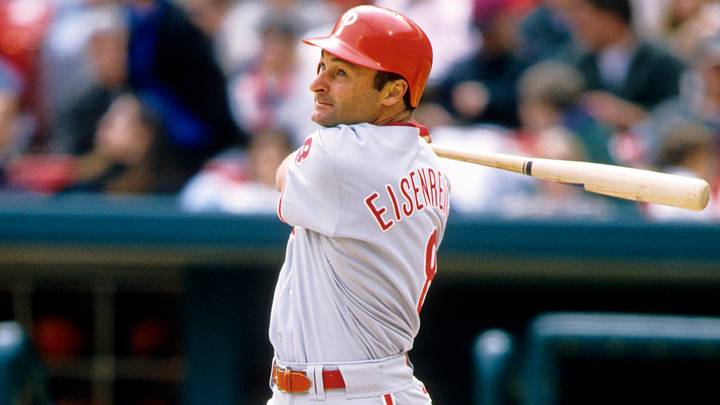
On November 24, 1993, the Philadelphia Phillies re-signed Jim Eisenreich to a $1.2 million contract (with bonuses) for the 1994 season. The deal included a club option at the same salary for the following campaign, as well. This agreement was interrupted by a 232-day MLB strike that wiped out the end of the 1994 regular season and the entire postseason, including the 1994 World Series.
Eisenreich's return occurred just a month after the team fell short to the Toronto Blue Jays in the 1993 World Series. Now the Phillies' goal was to shape their 'Memorable Group of Misfits' into yearly National League contenders. One of the key orders of business for general manager Lee Thomas was to retain an important member of the roster from that remarkable National League Pennant run in the fall of 1993. Philadelphia retained the veteran by nearly tripling his salary for the next two seasons.
Eisenreich was excellent during four seasons in Philadelphia
Eisenreich rewarded the Phillies' faith by posting similar numbers during the 1994 campaign. He collected 87 hits and batted .300 in 104 games until the strike took out the rest of the season. While his performance was solid, the Phillies sputtered to a 54-61 record after a 9-14 start, so a repeat playoff performance was unlikely by the time baseball shut down in August 1994.
While it may have been a lost season for the Phillies, Eisenreich certainly wasn’t treating those 1994 games as throwaways. He played the final three months of the 1994 season without committing an error, a streak that reached a then-franchise-record 208 games for an outfielder by the time it ended in 1996. Nick Castellanos surpassed his record for the longest string of error-free contests in the National League at 414 consecutive games, including time roaming the outfield at Citizens Bank Park between 2022 and 2024.
Eisenreich was perfect in 207 fielding opportunities during the 1995 season, while batting .316 with 119 hits, two home runs, and 55 RBI. Philly finished under .500 again in a shortened 69-75 campaign, 21 games behind the Atlanta Braves in the NL East.
Still, Eisenreich enjoyed his time in the City of Brotherly Love enough to re-up at the same rate ($1.2 million) for the 1996 season. A 36-year-old Eisenreich picked up 122 hits and a .361 batting average in 113 games. His 1996 performance was ranked as one of the top 10 seasons by a role player in team history, yet it was another wasted on a Phillies team that finished with a 67-95 record.
Eisenreich stayed in the division after agreeing to a two-year, $3 million contract with the Florida Marlins, plus a club option for the 1999 campaign. He helped the Marlins toward a 1997 World Series title with a two-run homer in the sixth inning of World Series Game 3 that helped erase a four-run Florida deficit.
Though it didn't come with the Phillies, at least Eisenreich finally got his ring.
 Add us as a preferred source on Google