

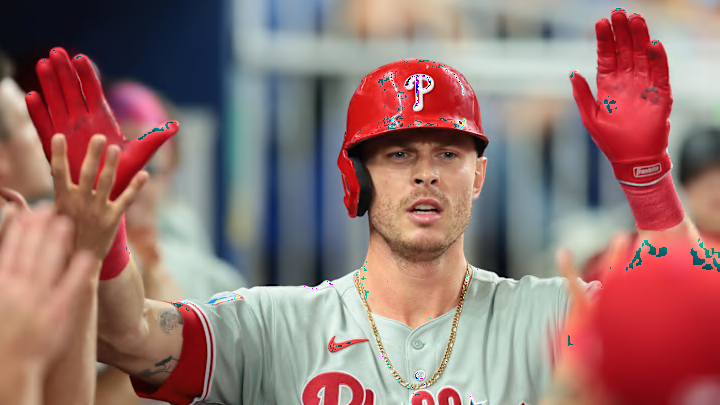
It feels as though the Philadelphia Phillies have been searching for a solution to their outfield woes for seasons now. Back in 2022, when this era of the Phillies began to take place, the trio that many expected to be patrolling the outfield would've been Brandon Marsh, Nick Castellanos, and Kyle Schwarber. Since then, the Phillies have experimented with numerous outfield configurations, attempting to stabilize this revolving door through both internal and external options. However, no players have seemed to stick, including the trio they tried for the first half of 2025, with Max Kepler expected to cover left field as a new addition.
Unfortunately for Kepler, at the beginning of the season, he was extremely streaky at the plate, resulting in some underwhelming offensive production, to say the least. In the first month of play, Kepler hit just .238 with two home runs and six runs batted in, not just lacking the "power" many believed he'd carry over from his former team, but leading to plenty of anticipation that the Phillies might move on from Kepler by the time the 2025 trade deadline rolled around.
After the club traded for a fellow former-Minnesota Twin in Harrison Bader at the deadline, many thought that Kepler's days were numbered, but after looking at Kepler's numbers after Bader's arrival, it seems as though the acquisition of the veteran center fielder has allowed Kepler to redefine himself at the plate.
Suddenly, he looks much more like a member of what the Phillies' outfield should look like.
Max Kepler has been on a quiet heater. Since Aug. 5th:
— Joseph Cammisa (@jcammisabsbl) September 6, 2025
.300/.348/.567 (.915 OPS)
8 XBH
4 HR
11 RBI
9.1 K%
.267 ISO
147 wRC+
91.0 MPH avg EV
Might be Greg Dobbs with juice pic.twitter.com/YEfl5FgxnS
Max Kepler is playing like he's the answer to the Phillies' issue in right field
Thomson's decision to platoon the continuously struggling Castellanos has allowed Kepler to shift over to right, leading to Bader assuming his primary position of center, and Marsh in left. This switch across the outfield has seemed to unlock something in Kepler, who has been the game-defining player in some of the team's most intense wins of the second half. After seeing some increased playing time, Kepler went from posting a .196 batting average and a .580 OPS in July to a .300 average and an .842 OPS the next month. He's also seemed to focus on his plate discipline, seeing his on-base percentage rise from .277 in July to .317 in August thanks to an increase in walks.
"I think I sat four games in a row [at some point in the first half],” Kepler said to MLB's Justin Morris, “and I had to accept [it] and swallow the ego, and understand that this is for the big picture, to win a World Series." Despite losing the "everyday" role, Kepler has clearly been on an upswing, with this positive change in mentality leading the charge, especially as he acclimates himself to right field.
While the sample size of at-bats is smaller for Kepler in right field, it's clear that this shift has helped him regain some confidence at the plate, which is tough when you play in front of one of the most demanding fan bases not just in baseball, but in all of sports. Most notably, Kepler's name began buzzing around after he and his outfield-mates all launched consecutive home runs. Since the series against the Rangers in early August, the Phillies' outfielder has consistently been working to improve, with the team recognizing his success at the plate by batting him fourth in the series opener against the Mets (he went 1-for-4). He has solidified himself as an outfield regular, regardless of where he's playing.
 Add us as a preferred source on Google