

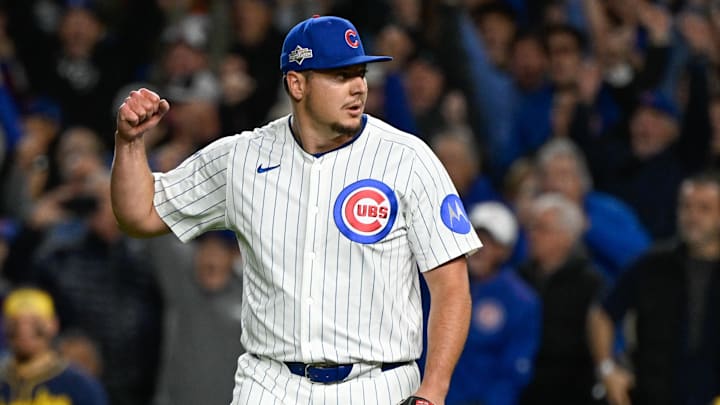
The Philadelphia Phillies signed right-hander Brad Keller to a two-year, $22 million contract on Wednesday, finalizing the deal on Thursday. Around the same time that deal happened, the rival New York Mets made a similar play, signing right-hander Luke Weaver to an identical contract.
With both NL East teams adding firepower to their bullpens for 2026, who came out on top in the dueling deals?
At 30, the 6-foot-5 Keller is two years younger than the 32-year-old Weaver, so there's easy bonus points for the Phillies. And just looking at their surface-level results from 2025, it's pretty obvious that Keller was the better pitcher.
In 68 games, Keller posted a 2.07 ERA (187 ERA+) with 75 strikeouts in 69 2/3 innings for the Chicago Cubs. Weaver, in 64 games, had a 3.62 ERA (113 ERA+) with 72 strikeouts in 64 2/3 innings for the New York Yankees.
Phillies' deal with Brad Keller looks better than the Mets' deal with Luke Weaver
Despite Keller's previous struggles as a starter/swingman and coming back from thoracic outlet syndrome surgery in October 2023, the Phillies obviously liked what they saw from him in his career year this past season. If you look under the hood, the signing looks even better than the Mets' move for Weaver.
Keller has an established repertoire with a five-pitch mix, compared to Weaver's three offerings. He averaged 97.2 mph on his fastball in 2025, ranking in the 88th percentile. Weaver sat at 95.1 mph, which dropped him to the 63rd percentile, down from the 77th percentile in 2024.
Keller also has a slider, sweeper, sinker, and changeup in his arsenal, an arsenal that put him in the 99th percentile with a 30.6 percent hard-hit rate. His nasty breaking pitches also served up a 95th percentile 56.6 percent ground ball rate. That all led to an average exit velocity of just 86.7 mph, which ranked in the top six percent in MLB.
Weaver has a better chase rate, whiff rate, and strikeout percentage than Keller, but it doesn't make up for the other things he falls short on. His ground ball rate sits at just 27.4 percent, in the bottom one percent of MLB. He also has one of the worst fly ball rates in baseball, paired with a lower-end extension on the mound. Among 147 qualified relievers in 2025, his 56.3 percent fly ball rate ranked the sixth-worst, which explains his 1.39 home runs per nine innings.
The deals are identical, but there's so much to worry about for the Mets with Weaver. His heavier reliance on his fastball with a dip in velocity spells disaster over the course of an entire season, paired with one of the worst fly ball rates in MLB.
Keller, on the other hand, avoids hard contact and maintains one of the best ground ball rates, joining none other than the MLB leader in ground ball percentage Jhoan Duran at a whopping 65 percent. Weaver may be flashier at times, but there's no denying that Keller is the better pitcher, and his makeup will make the Phillies' bullpen truly great in 2026.
 Add us as a preferred source on Google