

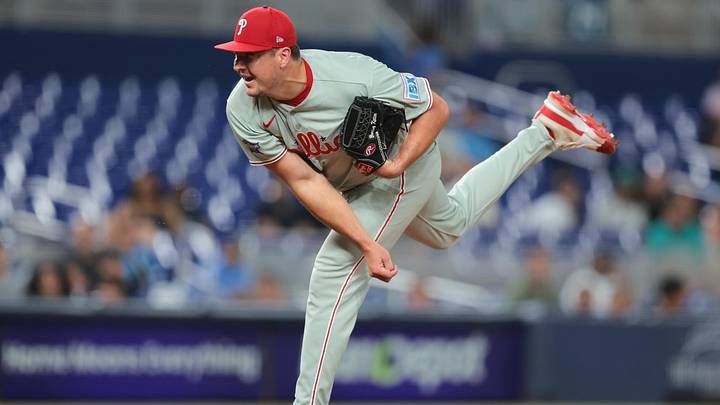
Thanks to the presence of Jhoan Duran, Philadelphia Phillies fans can feel relatively secure when entering the ninth inning with a lead. The 28-year-old fireballer has already locked down 18 saves this season, pitching to a 1.90 ERA and 1.33 FIP. However, sometimes it's proven to be a journey just to get to the final frame. Brad Keller was signed to mitigate the concern of bridging the gap between the rotation and closer, but instead, he's only added fuel to the fire.
Take, for instance, his latest outing against the Brewers over the weekend. Entering the eighth inning with a 9-5 lead, Keller promptly allowed three runs to cross home plate, walking two and surrendering three hits in the frame. That pushed the score to 9-8, necessitating an appearance from Duran to close things out.
His season-long stats aren't horrendous for a reliever -- he's got matching 4.15 ERA and FIP figures, plus a 23.7% strikeout rate -- but they don't paint the picture of someone who should be trusted in the highest-leverage moments. Now, the Phillies' stubborn adherence to Keller in these spots doesn't matter, as Keller is headed to the injured list with elbow tendinitis. Given the "void" left by Keller's injury, it is clear that Orion Kerkering has earned a chance at that job.
Brad Keller is a late IL placement with right forearm tendinitis. He played catch on the field earlier. Max Lazar is recalled.
— Matt Gelb (@MattGelb) June 16, 2026
Don Mattingly must make Orion Kerkering Phillies' set-up man with Brad Brad Keller headed to the injured list
Across the entire season, it's clear that Kerkering has been the superior pitcher. His 2.03 ERA and 3.25 FIP are noticeably better than Keller's marks, and his 25.9% punch-out rate is also ahead. Both are elite contact managers, but the former is on another level in that regard (his average exit velocity allowed is the best in baseball). Now, with Keller out, Kerkering has a chance to prove it.
Beyond just the numbers, though, it's clear which reliever has been more dependable. In high-leverage situations (loosely defined by Baseball Reference as situations in which win probability can shift in a non-negligible direction either way), Keller has faced 69 hitters and allowed an .856 OPS. Meanwhile, Kerkering has faced 28 hitters and stifled them to the tune of a .417 OPS. It would not be surprising in the slightest if the results play out the same way while Keller is out and Kerkering (hopefully) gets his shot.
It's also true that the two work in reverse depending on the leverage; batters have gotten to Kerkering for a .658 OPS in low-leverage spots, while they're managing a paltry .368 OPS in the same situations against Keller.
Naturally, the data sets are a little skewed here -- Keller has a far larger sample of high-leverage moments because he pitches in the eighth inning, and because he allows more runners to reach base -- but it's clear who has responded to pressure better this season. Perhaps having learned a lesson from his all-time gaffe last October, Kerkering has been the cooler customer on the mound.
It does not feel great to celebrate a player being injured, especially one with a career as distinguished as Keller's has been. However, in this particular case, it may be the catalyst that the Phillies needed to make the change in bullpen roles that was long overdue.
 Add us as a preferred source on Google